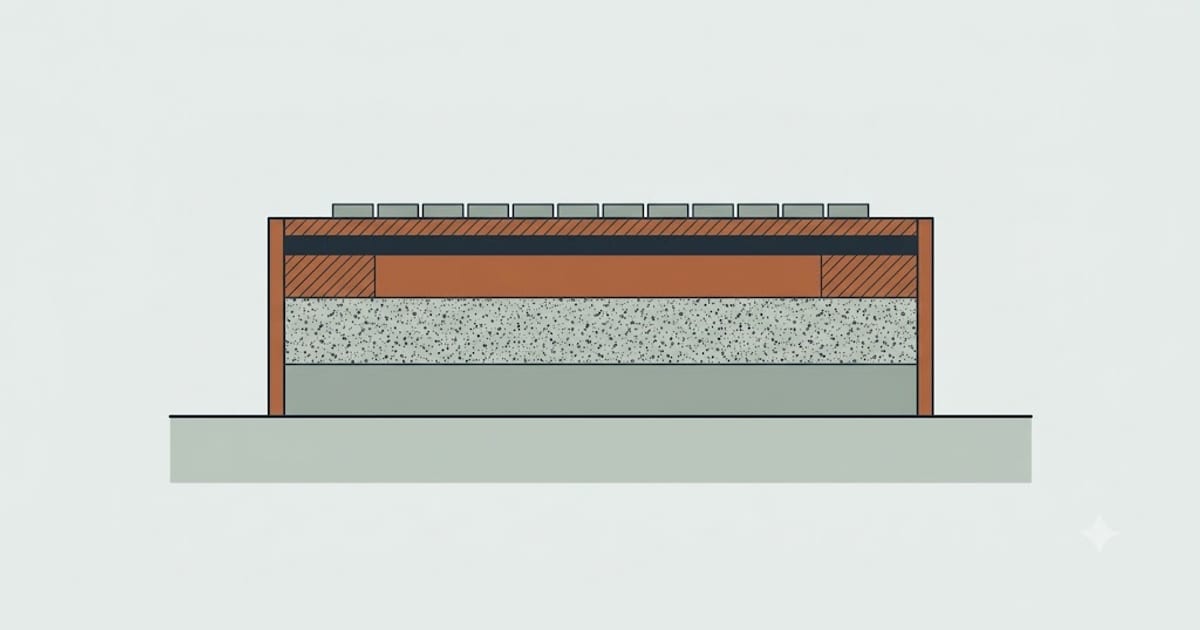
A paver patio is three layers, and the two you cannot see are the ones that decide whether it is still flat in five years.
What each layer costs
Prices are typical US supply-yard figures per cubic yard delivered, converted to a per-square-foot cost at the depth given.
| Layer | Depth | Material | Cost per ft² |
|---|---|---|---|
| Compacted gravel base | 4" (patio) | Crushed stone, ¾" minus | $0.55–1.10 |
| Compacted gravel base | 6" (drive) | Crushed stone, ¾" minus | $0.85–1.65 |
| Bedding course | 1" | Coarse concrete sand | $0.20–0.35 |
| Joint filling | — | Polymeric sand | $0.15–0.30 |
On a 300 ft² patio that is roughly $270–525 of base and sand before a single paver is bought. Pavers themselves run $3–8/ft², so the base is around 10–15% of material cost — and closer to a third if you are laying reclaimed or budget pavers.
Depth is set by what goes on top
| Use | Base depth |
|---|---|
| Walkway, foot traffic only | 4" |
| Patio | 4–6" |
| Driveway, cars | 8–12" |
| Clay soil, poor drainage | add 2" |
| Freeze-thaw region | add 2" |
Clay and frost both add depth for the same reason: they hold water, and water that freezes under a patio lifts it.
Where the money is actually lost
Uncompacted base. Gravel dumped and raked is not a base. It has to go down in lifts of no more than 4 inches, each one compacted with a plate compactor before the next. A 6" base laid in one lift will settle unevenly no matter how much stone was bought.
The wrong sand. The bedding course must be coarse concrete sand, not play sand and not stone dust. Fine sand holds water and migrates; stone dust compacts into something closer to concrete and stops the bed draining. This is a $30 mistake that costs a patio.
No edge restraint. Without a restraint the perimeter pavers creep outward, the joints open, and the field follows. Plastic edging is around $1.50–3 per linear foot and it is not optional.
Worked example
A 12 × 20 ft patio, 4" base, mixed soil:
- Area: 240 ft²
- Base at 4": 240 × 0.333 ft ÷ 27 = 2.96 yd³, plus 10% compaction allowance = 3.3 yd³ → $130–230
- Sand at 1": 240 × 0.083 ÷ 27 = 0.74 yd³ → $50–85
- Edge restraint: 64 linear ft → $95–190
- Polymeric sand: 240 ft² at 1 bag per 80 ft² = 3 bags → $60–105
Base package: $335–610. The paver calculator works the same figures from your own dimensions.
The allowance people forget
Gravel is sold loose and installed compacted. It loses roughly 10–20% of its volume going from the delivery pile to a compacted base, and every calculator that skips that allowance leaves you a quarter-load short on the last lift. Order the extra; leftover ¾" minus is useful for a hundred other things and delivery of a second part-load is not cheap.
Geotextile fabric — $0.15/ft² that decides the lifespan
A woven geotextile between the subgrade and the gravel stops the two mixing. Without it, the base slowly sinks into soft soil and the soil pumps up into the base, and after a few wet winters you have a layer of gravelly mud that neither drains nor supports.
| Soil | Fabric | Cost |
|---|---|---|
| Sandy, free-draining | optional | — |
| Loam | worth it | $0.10–0.20/ft² |
| Clay | not optional | $0.15–0.25/ft² |
| Anything that stays wet | non-woven + extra base depth | $0.20–0.30/ft² |
On the 240 ft² example that is $25–60. It is the cheapest thing on the list and the one most often skipped.
Slope is free and it is the other half of drainage
A patio needs to fall 1/4 inch per foot away from the house — about 2%. Over a 12 ft run that is 3 inches of drop, and it has to be built into the base, not into the paver layer.
Getting this wrong costs nothing in materials and everything in outcome: water that sits on a patio in a freeze-thaw climate gets under the pavers, freezes, and lifts them. A perfectly level patio is a failed patio.
Set string lines to the finished paver height, subtract the paver thickness and the 1" sand bed, and screed the base to that. Checking with a level and a tape as you go is faster than fixing one dip afterwards, because fixing a dip means lifting the pavers, adding base, recompacting and re-screeding that whole area.
Ordering summary
For a patio of area A square feet at a 4" base:
- Gravel: A × 0.333 ÷ 27 yd³, then add 15% for compaction
- Sand: A × 0.083 ÷ 27 yd³, then add 10%
- Fabric: A plus 10% for overlaps at the seams
- Edge restraint: the perimeter, plus a spike every 12 inches
- Polymeric sand: one bag per 80 ft² for standard joints, per 50 ft² for wide ones
Order the gravel and sand together if the yard delivers — a second delivery charge is usually $60–120 and it is more than the material you were short.