Concrete Piers & Sonotubes
Concrete for round piers and deck footings — volume, bag counts, rebar and the bearing capacity that decides whether the pier is big enough in the first place.
A round pier is π r² h — no geometry to argue about. The interesting question is not how much concrete goes in, but whether the pier is big enough for what sits on it.
Bearing area is the number that matters
An 8″ pier bears on 0.35 ft² of soil. At the 1,500 psf that the IRC lets you assume when nobody has tested the ground, that carries about 520 lb. A 12″ pier bears on 0.79 ft² and carries about 1,180 lb.
Deck loads add up faster than that suggests: 50 psf of combined live and dead load over the tributary area each pier supports. A pier carrying a 6 × 8 ft patch of deck is holding 2,400 lb, and an 8″ pier is not enough for it.
Every calculator on the internet will tell you the bag count. Very few will tell you the pier is undersized.
Presumptive soil is a guess, and a generous one
Fifteen hundred pounds per square foot is what the code allows in the absence of a soil test. Soft clay, peat or anything that has been filled can be a third of that. If the hole augers easily all the way down, be suspicious.
Wet mix, not dry pour
Fence posts can be dry-poured. Piers cannot. This is a load-bearing element, and dry-poured concrete cures unevenly and never reaches its rated strength. Mix it properly, or order it.
Depth is set by frost, not by load
The bottom of the pier goes below the frost line, on undisturbed soil. A pier that heaves lifts the structure with it, and it will do that whether it is 8″ across or 24″.
1 article
Concrete for 8 × 12″ piers, 36″ deep
| 80 lb bags0.6 ft³ per bag | 35bags |
|---|---|
| 60 lb bags0.45 ft³ per bag | 47bags |
| 50 lb bags0.375 ft³ per bag | 56bags |
| Total volume0.77 yd³, includes 10% waste | 20.73ft³ |
| Per pierbefore waste | 2.36ft³ |
| Ready-mix | 0.77yd³ |
| Rebar (4 × #4 vertical)3″ cover top and bottom | 80linear ft |
| Forming tube12″ diameter | 24ft |
| Bearing areathe footprint carrying the load | 0.79ft² |
| Allowable loadat 1,500 psf presumptive soil — check yours | 1,178lb |
Notes
- Under 1 yd³, bagged mix wins. 35 × 80 lb bags is about 2,800 lb of material to move — plan the mixing before you start, because piers have to be poured in one go.
- A 12″ pier bears on 0.79 ft², which carries about 1,178 lb on 1,500 psf soil. That is the presumptive value the IRC allows when nobody has tested the soil; soft clay or fill can be a third of it, and the pier does not care how many bags went into it if the ground underneath moves.
- Depth is set by the frost line, not by the load. 36″ clears most of the southern and central US; the northern tier runs 48–60″. A pier poured above the frost line lifts every winter and takes the structure with it.
- Use a proper wet mix, not the dry-pour method that works for fence posts. This is a load-bearing element — dry-poured concrete cures unevenly and never reaches its rated strength.
- Rebar is 4 × #4 here, which is normal practice for deck and porch piers. Anything carrying a roof, a second storey or a beam splice wants a structural drawing rather than a rule of thumb.
Concrete for a round pier
96 calculations · browse all
- Concrete for 1 × 6″ piers, 12″ deep
- Concrete for 1 × 10″ piers, 12″ deep
- Concrete for 1 × 14″ piers, 12″ deep
- Concrete for 1 × 18″ piers, 12″ deep
- Concrete for 2 × 6″ piers, 12″ deep
- Concrete for 2 × 10″ piers, 12″ deep
- Concrete for 2 × 14″ piers, 12″ deep
- Concrete for 2 × 18″ piers, 12″ deep
- Concrete for 3 × 6″ piers, 12″ deep
- Concrete for 3 × 10″ piers, 12″ deep
- Concrete for 3 × 14″ piers, 12″ deep
- Concrete for 3 × 18″ piers, 12″ deep
- Concrete for 4 × 6″ piers, 12″ deep
- Concrete for 4 × 10″ piers, 12″ deep
- Concrete for 4 × 14″ piers, 12″ deep
- Concrete for 4 × 18″ piers, 12″ deep
- Concrete for 6 × 6″ piers, 12″ deep
- Concrete for 6 × 10″ piers, 12″ deep
- Concrete for 6 × 14″ piers, 12″ deep
- Concrete for 6 × 18″ piers, 12″ deep
- Concrete for 8 × 6″ piers, 12″ deep
- Concrete for 8 × 10″ piers, 12″ deep
- Concrete for 8 × 14″ piers, 12″ deep
- Concrete for 8 × 18″ piers, 12″ deep
- Concrete for 9 × 6″ piers, 12″ deep
- Concrete for 9 × 10″ piers, 12″ deep
- Concrete for 9 × 14″ piers, 12″ deep
- Concrete for 9 × 18″ piers, 12″ deep
- Concrete for 10 × 6″ piers, 12″ deep
- Concrete for 10 × 10″ piers, 12″ deep
- Concrete for 10 × 14″ piers, 12″ deep
- Concrete for 10 × 18″ piers, 12″ deep
- Concrete for 12 × 6″ piers, 12″ deep
- Concrete for 12 × 10″ piers, 12″ deep
- Concrete for 12 × 14″ piers, 12″ deep
- Concrete for 12 × 18″ piers, 12″ deep
- Concrete for 16 × 6″ piers, 12″ deep
- Concrete for 16 × 10″ piers, 12″ deep
- Concrete for 16 × 14″ piers, 12″ deep
- Concrete for 16 × 18″ piers, 12″ deep
- Concrete for 20 × 6″ piers, 12″ deep
- Concrete for 20 × 10″ piers, 12″ deep
- Concrete for 20 × 14″ piers, 12″ deep
- Concrete for 20 × 18″ piers, 12″ deep
- Concrete for 24 × 6″ piers, 12″ deep
- Concrete for 24 × 10″ piers, 12″ deep
- Concrete for 24 × 14″ piers, 12″ deep
- Concrete for 24 × 18″ piers, 12″ deep
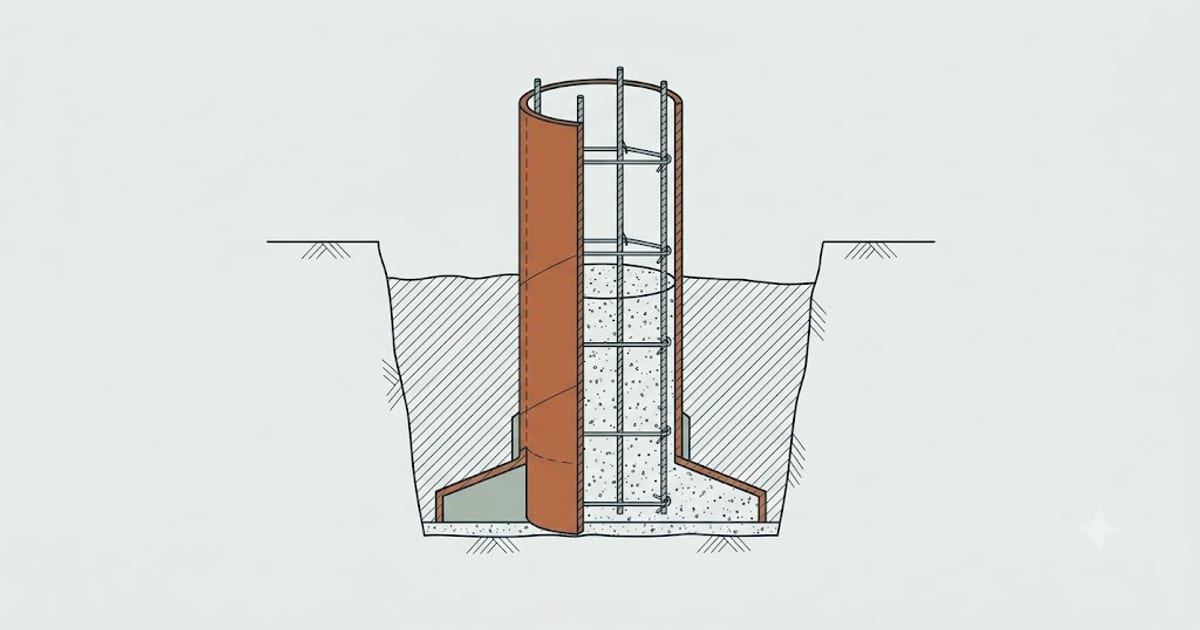 Concrete for a Sonotube: Volume, Bag Counts, and the Bell at the Bottom
The volume of a cylinder is the easy part. What surprises people is how fast it grows with diameter, and what happens to a tube full of wet concrete that was not braced.