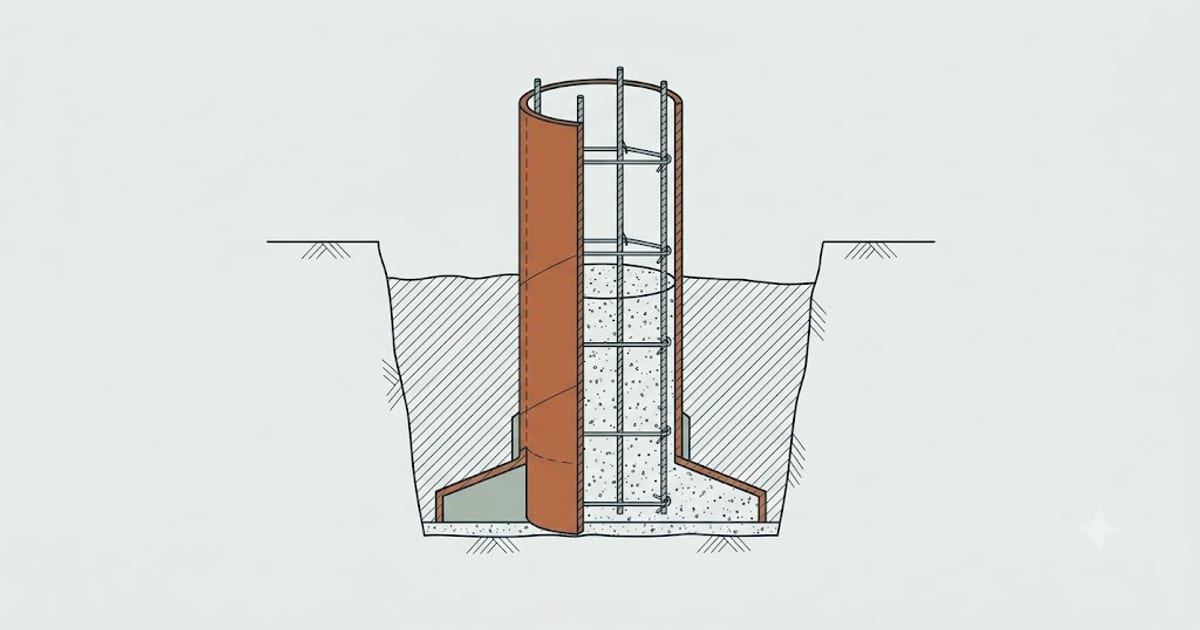
A cardboard form tube gives a clean round pier and a predictable volume. The arithmetic is πr²h — but the useful thing to know before ordering is how sharply that scales.
| Diameter | ft³ per foot of depth | 80 lb bags per foot |
|---|---|---|
| 6 in | 0.196 | 0.33 |
| 8 in | 0.349 | 0.58 |
| 10 in | 0.545 | 0.91 |
| 12 in | 0.785 | 1.31 |
| 14 in | 1.069 | 1.78 |
| 16 in | 1.396 | 2.33 |
| 18 in | 1.767 | 2.95 |
Doubling the diameter quadruples the concrete. A 12-inch pier at 4 ft deep is 3.14 ft³ — about 5¼ bags. The same pier at 16 inches is 5.59 ft³, nearly 9½ bags. Six of them, and you have crossed from bags into a ready-mix conversation.
Work it out per pier and in total on the pier calculator — the crossover to a truck arrives sooner than most people expect.
The tube is a form, not a footing
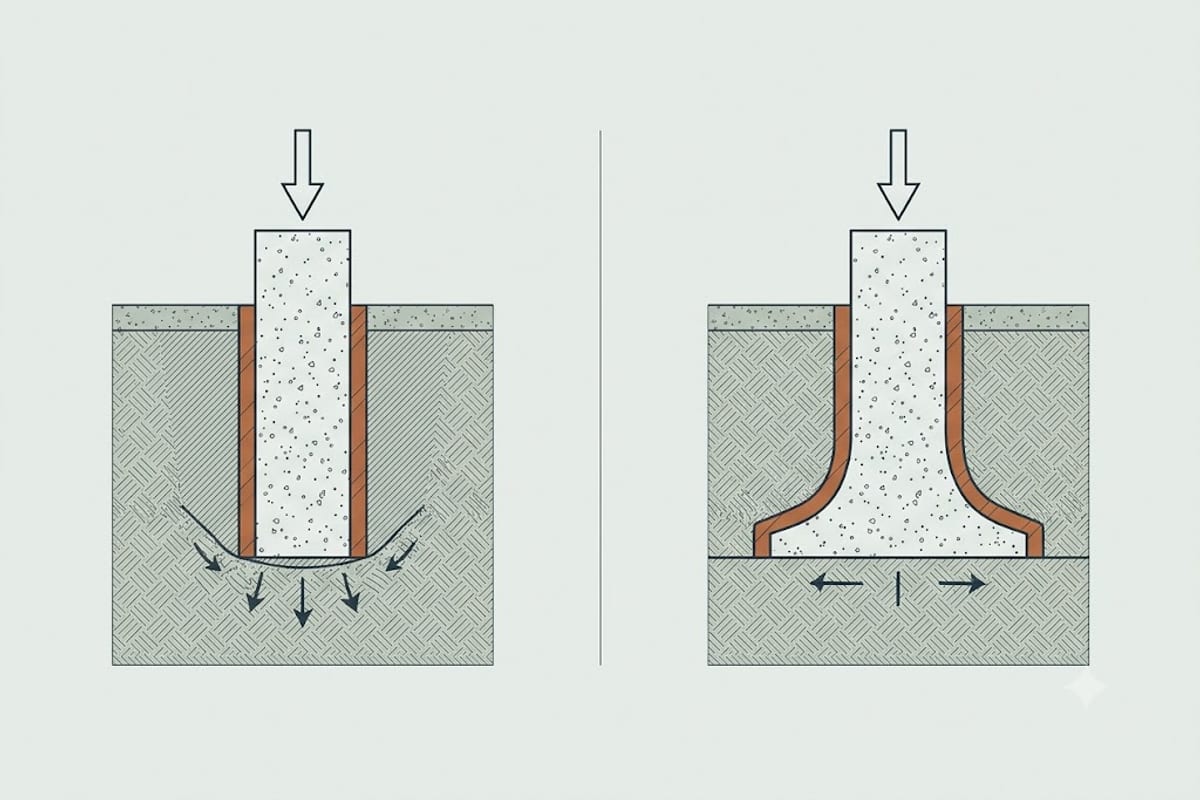
This is the most consequential misunderstanding about form tubes. A 12-inch tube gives 0.785 ft² of bearing at the bottom. On 2,000 psf soil that carries 1,570 lb.
For a deck post carrying 2,400 lb it is not enough — and the shortfall does not show up as a crack. It shows as a pier that slowly sinks, taking one corner of the structure with it.
Two fixes:
A footing pad below the tube. Excavate wider at the bottom, pour a square or round pad 6 to 8 inches thick, and set the tube on it. Two pours, or one continuous one if the hole holds.
A bell-bottom form. A plastic footing form that clips to the base of the tube and flares it to 20 or 24 inches. One pour, considerably more bearing, and the usual choice for deck work.
Tubes float
A cardboard tube in a wet hole, filled with concrete, will lift. So will one that is not braced when the concrete is placed unevenly. The concrete goes in fast, the tube moves, and you discover it when it has set.
Brace every tube against two stakes at right angles, check plumb, and check it again after filling. Concrete placement moves things.
Fill in lifts and consolidate
Pouring a 4-foot tube in one go traps air against the form wall, leaving honeycombed voids that show as pitted grey pockets when the tube comes off.
Fill in 12 to 18 inch lifts and rod each one — a length of rebar worked up and down is enough on a pier this size. Tapping the outside of the tube with a hammer as you go helps the surface.
Rebar, and where it goes
Vertical bars are what let a pier resist lateral load and uplift rather than only compression. Three or four #4 bars, tied in a cage with ties every 12 inches, held clear of the form so they finish with at least 3 inches of cover on all sides where concrete is cast against earth.
Bars pushed in after the pour, or bars touching the form, do very little. The cover is what protects them from corrosion, and rusting rebar expands and splits the pier.
Stripping and finishing
Peel the tube within a few days — the spiral seam tears easily while the concrete is green and becomes a chore once it is not. Leaving cardboard in the ground holds moisture against the concrete and eventually rots into a void.
Above grade, the spiral witness line stays visible. It sands off, or it can be rubbed with a cement paste while green if the pier is in a visible position.