Concrete Step Calculators
Concrete for poured steps, where the volume grows with the square of the step count — plus the code limits and the comfort rule that decide whether they are pleasant to walk.
Concrete for steps does not scale with the number of steps. It scales with the square of it.
The bottom step carries the full depth of every step above it. Four steps is ten step-blocks of material, not four. Multiply one step's volume by the step count — which is what most step calculators do — and you will be short by more than half on anything above three steps.
The correct figure is rise × run × n(n+1)/2, times the width.
Two checks, and they are different
Code. The IRC allows a maximum 7¾″ rise and requires at least a 10″ run. There is a third rule that catches more people than either: no more than ⅜″ variation between the tallest and shortest riser in one flight. With concrete you get exactly one attempt at that.
Comfort. Carpenters check 2 × rise + run and want the result between 24 and 25 inches. Steps that satisfy code can still feel wrong underfoot — too quick, or a stretch that people take two at a time — and this is the check that catches it.
Get the total rise first, then divide
Measure from the finished landing down to the finished grade, then divide by a whole number of steps. Fudging the bottom riser to absorb a leftover inch is precisely what the ⅜″ rule exists to prevent, and it is exactly what people do when they work the other way round.
They project further than you think
Four steps at an 11″ run stick out 3 ft 8 in from the wall. That measurement is the one that collides with paths, driveways and property lines, and it is usually discovered after the forms are built.
Under them
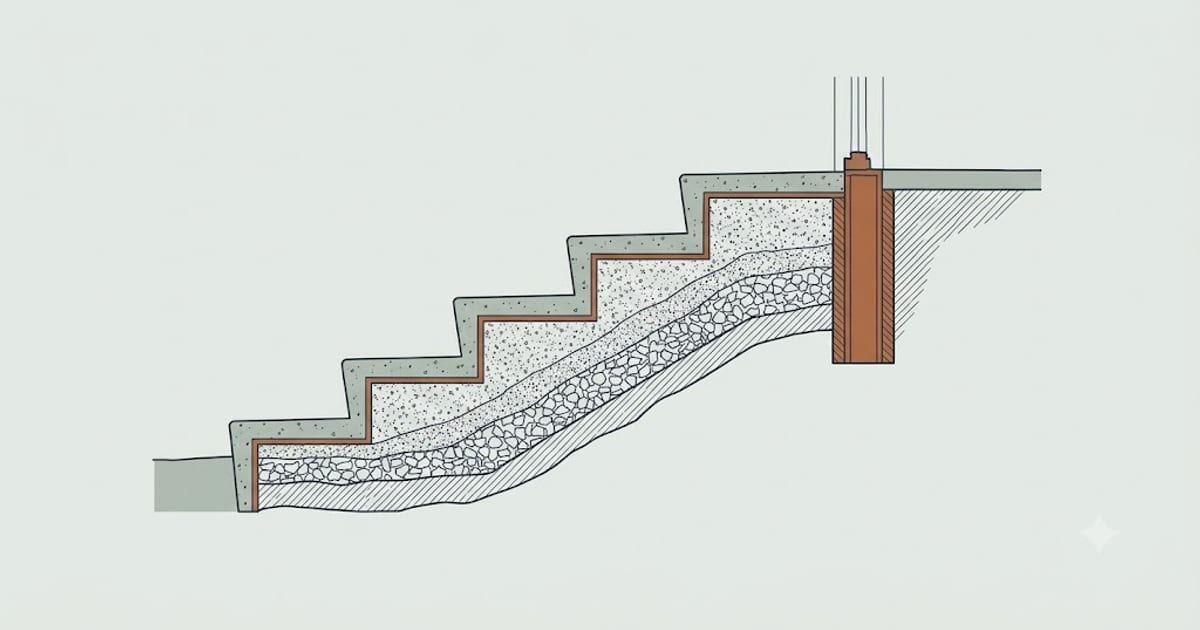
Compacted gravel across the whole footprint, below the frost line at the front edge. Steps that heave separate from the house at the top and open a gap that grows a little every winter.
1 article
Concrete for 5 steps: 54″ wide, 7″ rise, 11″ run
| Ready-mix | 1.47yd³ |
|---|---|
| 80 lb bags | 67bags |
| 60 lb bags | 89bags |
| Volume (order this)+10% waste | 39.7ft³ |
| Total rise5 × 7″ | 2.92ft |
| Total run5 × 11″ — how far it projects | 4.58ft |
| Gravel base (6″) | 10.3ft³ |
| Side formstwo stepped cheeks | 16ft² |
| Riser boards5 risers, 54″ wide | 13.1ft² |
| Rebar #4 @ 12″ grid | 56linear ft |
| Code check — rise7″ against the 7¾″ IRC maximum | OK |
| Code check — run11″ against the 10″ IRC minimum | OK |
| Comfort (2R + T)inside the 24–25″ comfortable range | 25in |
Notes
- Concrete goes up with the square of the step count, not in a straight line. The bottom step carries the full depth of everything above it, so 5 steps is 15 step-blocks of material, not 5. Multiplying one step's volume by 5 — which is what most step calculators do — would give 12 ft³ instead of the real 36.1.
- 7″ rise and 11″ run are both inside the IRC limits (7¾″ maximum rise, 10″ minimum run). The rule that catches people out is the third one: no more than ⅜″ variation between the tallest and shortest riser in a flight. With concrete you get one attempt at that.
- 2R + T comes to 25″, inside the 24–25″ band that carpenters use for a comfortable stride. Steps that satisfy code can still feel wrong, and this is the check that catches it.
- Get the total rise right first, then divide. Measure from the finished landing down to the finished grade — 2.92 ft here — and divide by a whole number of steps. Fudging the bottom riser to absorb an error is exactly what the ⅜″ rule exists to prevent.
- They project 4.58 ft from the wall. That is the measurement that collides with paths, driveways and property lines, and it is usually discovered after the forms are built.
- Compacted gravel under the whole footprint, below the frost line at the front edge. Steps that heave separate from the house at the top and open a gap you can watch grow every winter.
Concrete for steps
56 calculations · browse all
- Concrete for 2 steps: 36″ wide, 6″ rise, 10″ run
- Concrete for 2 steps: 42″ wide, 6″ rise, 10″ run
- Concrete for 2 steps: 48″ wide, 6″ rise, 10″ run
- Concrete for 2 steps: 54″ wide, 6″ rise, 10″ run
- Concrete for 2 steps: 60″ wide, 6″ rise, 10″ run
- Concrete for 2 steps: 72″ wide, 6″ rise, 10″ run
- Concrete for 2 steps: 96″ wide, 6″ rise, 10″ run
- Concrete for 3 steps: 36″ wide, 6″ rise, 10″ run
- Concrete for 3 steps: 42″ wide, 6″ rise, 10″ run
- Concrete for 3 steps: 48″ wide, 6″ rise, 10″ run
- Concrete for 3 steps: 54″ wide, 6″ rise, 10″ run
- Concrete for 3 steps: 60″ wide, 6″ rise, 10″ run
- Concrete for 3 steps: 84″ wide, 6″ rise, 10″ run
- Concrete for 3 steps: 96″ wide, 6″ rise, 10″ run
- Concrete for 4 steps: 36″ wide, 6″ rise, 10″ run
- Concrete for 4 steps: 42″ wide, 6″ rise, 10″ run
- Concrete for 4 steps: 48″ wide, 6″ rise, 10″ run
- Concrete for 4 steps: 54″ wide, 6″ rise, 10″ run
- Concrete for 4 steps: 72″ wide, 6″ rise, 10″ run
- Concrete for 4 steps: 84″ wide, 6″ rise, 10″ run
- Concrete for 4 steps: 96″ wide, 6″ rise, 10″ run
- Concrete for 5 steps: 36″ wide, 6″ rise, 10″ run
- Concrete for 5 steps: 42″ wide, 6″ rise, 10″ run
- Concrete for 5 steps: 48″ wide, 6″ rise, 10″ run
- Concrete for 5 steps: 60″ wide, 6″ rise, 10″ run
- Concrete for 5 steps: 72″ wide, 6″ rise, 10″ run
- Concrete for 5 steps: 84″ wide, 6″ rise, 10″ run
- Concrete for 5 steps: 96″ wide, 6″ rise, 10″ run
- Concrete for 6 steps: 36″ wide, 6″ rise, 10″ run
- Concrete for 6 steps: 42″ wide, 6″ rise, 10″ run
- Concrete for 6 steps: 54″ wide, 6″ rise, 10″ run
- Concrete for 6 steps: 60″ wide, 6″ rise, 10″ run
- Concrete for 6 steps: 72″ wide, 6″ rise, 10″ run
- Concrete for 6 steps: 84″ wide, 6″ rise, 10″ run
- Concrete for 6 steps: 96″ wide, 6″ rise, 10″ run
- Concrete for 7 steps: 36″ wide, 6″ rise, 10″ run
- Concrete for 7 steps: 48″ wide, 6″ rise, 10″ run
- Concrete for 7 steps: 54″ wide, 6″ rise, 10″ run
- Concrete for 7 steps: 60″ wide, 6″ rise, 10″ run
- Concrete for 7 steps: 72″ wide, 6″ rise, 10″ run
- Concrete for 7 steps: 84″ wide, 6″ rise, 10″ run
- Concrete for 7 steps: 96″ wide, 6″ rise, 10″ run
- Concrete for 8 steps: 42″ wide, 6″ rise, 10″ run
- Concrete for 8 steps: 48″ wide, 6″ rise, 10″ run
- Concrete for 8 steps: 54″ wide, 6″ rise, 10″ run
- Concrete for 8 steps: 60″ wide, 6″ rise, 10″ run
- Concrete for 8 steps: 72″ wide, 6″ rise, 10″ run
- Concrete for 8 steps: 84″ wide, 6″ rise, 10″ run
 Concrete Steps: The Rise That Divides Evenly, and the Code That Limits It
Concrete steps are one of the few pours where the geometry has to be resolved before the volume, and where the code sets a tolerance measured in eighths of an inch.