Block Wall Calculators
Blocks, mortar, rebar and grout for a CMU wall — with the footing under it and the engineering threshold that decides whether you can build it at all.
1.125 blocks per square foot. That number already includes the ⅜″ mortar joints, which is why nominal block sizes divide so cleanly into wall areas.
A block sold as 8×8×16 actually measures 7⅝ × 7⅝ × 15⅝ inches. The missing ⅜″ on each dimension is the joint. Lay it with the joint and the block occupies exactly 8 × 16 inches of wall.
Mortar and grout are different things
Mortar is what the blocks sit in — about 3 bags of Type S per 100 blocks at ⅜″ joints.
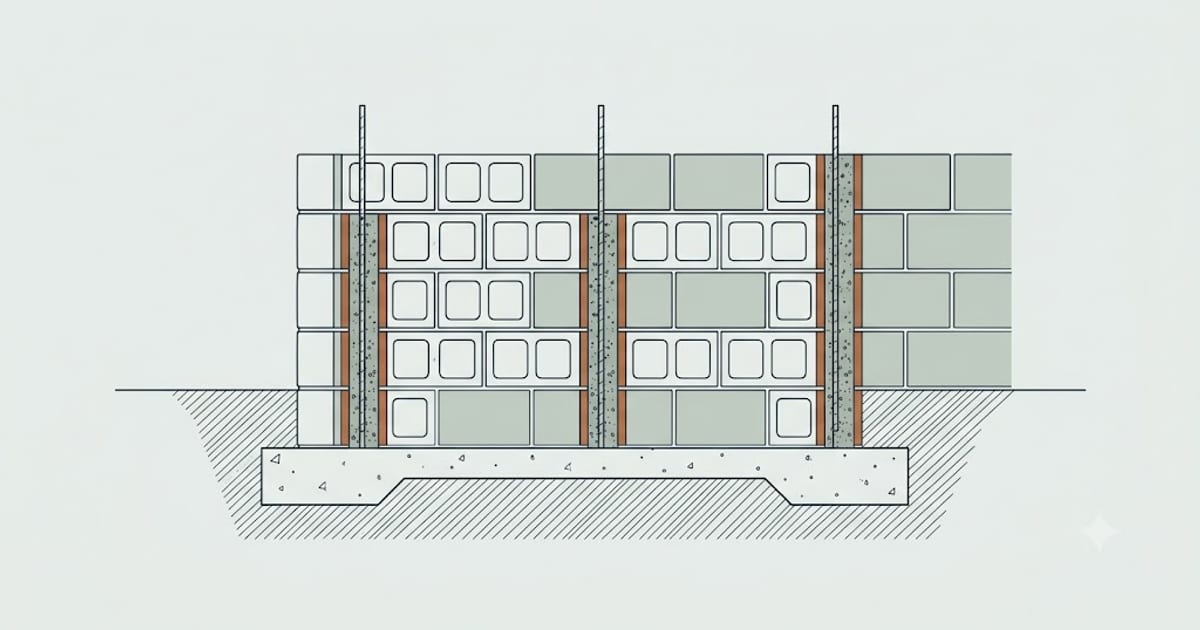
Grout is what fills the hollow cells, and it goes only in the cells that have steel in them. Solid-grouting a whole wall is a different job entirely, with several times the material and a footing sized for several times the load. Most estimates conflate the two and come out badly wrong in one direction or the other.
Four feet is the line
Under about 4 ft, a straightforward garden or stem wall is normally within prescriptive rules a homeowner can build to. Over it — and universally if it retains soil — most jurisdictions want an engineered design and a permit.
The reason is that soil pushes sideways with a force that grows with the square of the height. Double the wall height and the overturning force roughly quadruples. Walls sized by rule of thumb do not fail by crushing; they tip over.
Drainage is not optional behind a retaining wall
Gravel backfill, a perforated pipe at the base, weep holes through the wall. Water pressure behind a wall is a larger force than the soil itself, and saturated backfill is what actually pushes walls over.
The footing decides the lifespan
Twice the wall thickness, at least 8″ deep, below the frost line, on undisturbed soil. Block laid on a footing that heaves cracks along the mortar joints, and there is no repair short of taking it down.
1 article
Block wall materials for 52 ft at 7 courses, rebar every 32″
| Blocks (with 5% breakage) | 287blocks |
|---|---|
| Blocks (exact)1.125 per ft² including joints | 273blocks |
| Wall area52 ft × 4.67 ft | 243ft² |
| Wall height7 courses at 8″ | 4.67ft |
| Mortar (Type S, 70 lb)3 bags per 100 blocks at ⅜″ joints | 9bags |
| Masonry sandif mixing from bagged cement and lime instead | 1.2yd³ |
| Vertical rebar (#4 @ 32″)130 linear ft including 18″ into the footing | 21bars |
| Grout for filled cells64 × 80 lb bags — only the cells with steel in them | 38.2ft³ |
| Footing16″ × 8″ × 52 ft — twice the wall thickness | 1.71yd³ |
| Engineering4.67 ft is over the 4 ft threshold | Required |
Notes
- 1.125 blocks per square foot is the number, and it already includes the ⅜″ mortar joints. A "8×8×16" block is 7⅝ × 7⅝ × 15⅝ actual — the missing ⅜″ is the joint, which is why nominal dimensions divide so cleanly into wall areas.
- Grout goes only in the cells that have steel in them — 21 cells here, 38.2 ft³. Solid-grouting the whole wall is a different job with several times the material and a footing sized for several times the load.
- At 4.67 ft this is past the point where most jurisdictions want an engineered design and a permit — universally so if it retains soil. Soil pushes sideways with a force that grows with the square of the height, and a wall sized by rule of thumb fails by overturning, not by crushing.
- The footing decides whether the wall lasts. 16″ × 8″ is the usual rule of twice the wall thickness, below the frost line, on undisturbed soil. Block laid on a footing that heaves cracks along the mortar joints, and there is no repair short of rebuilding.
- Drainage behind any wall holding back soil is not optional: gravel backfill, a perforated pipe at the base and weep holes. Water pressure behind a wall is a larger force than the soil itself, and it is what actually pushes walls over.
Block wall materials
264 calculations · browse all
- Block wall materials for 8 ft at 2 courses, rebar every 24″
- Block wall materials for 8 ft at 7 courses, rebar every 24″
- Block wall materials for 12 ft at 2 courses, rebar every 24″
- Block wall materials for 12 ft at 7 courses, rebar every 24″
- Block wall materials for 16 ft at 2 courses, rebar every 24″
- Block wall materials for 16 ft at 7 courses, rebar every 24″
- Block wall materials for 20 ft at 2 courses, rebar every 24″
- Block wall materials for 20 ft at 7 courses, rebar every 24″
- Block wall materials for 24 ft at 2 courses, rebar every 24″
- Block wall materials for 24 ft at 7 courses, rebar every 24″
- Block wall materials for 28 ft at 2 courses, rebar every 24″
- Block wall materials for 28 ft at 7 courses, rebar every 24″
- Block wall materials for 32 ft at 2 courses, rebar every 24″
- Block wall materials for 32 ft at 7 courses, rebar every 24″
- Block wall materials for 36 ft at 2 courses, rebar every 24″
- Block wall materials for 36 ft at 7 courses, rebar every 24″
- Block wall materials for 40 ft at 2 courses, rebar every 24″
- Block wall materials for 40 ft at 7 courses, rebar every 24″
- Block wall materials for 44 ft at 2 courses, rebar every 24″
- Block wall materials for 44 ft at 7 courses, rebar every 24″
- Block wall materials for 48 ft at 2 courses, rebar every 24″
- Block wall materials for 48 ft at 7 courses, rebar every 24″
- Block wall materials for 52 ft at 2 courses, rebar every 24″
- Block wall materials for 52 ft at 7 courses, rebar every 24″
- Block wall materials for 56 ft at 2 courses, rebar every 24″
- Block wall materials for 56 ft at 7 courses, rebar every 24″
- Block wall materials for 60 ft at 2 courses, rebar every 24″
- Block wall materials for 60 ft at 7 courses, rebar every 24″
- Block wall materials for 64 ft at 2 courses, rebar every 24″
- Block wall materials for 64 ft at 7 courses, rebar every 24″
- Block wall materials for 68 ft at 2 courses, rebar every 24″
- Block wall materials for 68 ft at 7 courses, rebar every 24″
- Block wall materials for 72 ft at 2 courses, rebar every 24″
- Block wall materials for 72 ft at 7 courses, rebar every 24″
- Block wall materials for 76 ft at 2 courses, rebar every 24″
- Block wall materials for 76 ft at 7 courses, rebar every 24″
- Block wall materials for 80 ft at 2 courses, rebar every 24″
- Block wall materials for 80 ft at 7 courses, rebar every 24″
- Block wall materials for 84 ft at 2 courses, rebar every 24″
- Block wall materials for 84 ft at 7 courses, rebar every 24″
- Block wall materials for 88 ft at 2 courses, rebar every 24″
- Block wall materials for 88 ft at 7 courses, rebar every 24″
- Block wall materials for 92 ft at 2 courses, rebar every 24″
- Block wall materials for 92 ft at 7 courses, rebar every 24″
- Block wall materials for 96 ft at 2 courses, rebar every 24″
- Block wall materials for 96 ft at 7 courses, rebar every 24″
- Block wall materials for 100 ft at 2 courses, rebar every 24″
- Block wall materials for 100 ft at 7 courses, rebar every 24″
 How Many Blocks for a Wall: The 1.125 Rule and What It Leaves Out
A standard block covers exactly 0.889 square feet of wall including its mortar joint, which is why one number does all the work — and why the block count is the least of your problems.