Footings & Posts
A strip footing is width × thickness × length. The volume is trivial. What is not trivial is the steel, and that is where footing estimates come up short.
Rebar, with the laps counted
The IRC minimum for a reinforced footing is two continuous #4 bars, and footings 20″ and wider normally take three. Rebar comes in 20 ft sticks, and every joint needs a lap of 40 bar diameters — 20 inches for a #4.
Over a 60 ft footing with three bars, that is 180 ft of bar plus 10 ft of laps. Order the flat number and you will be one stick short on the day, which is not a recoverable mistake once the concrete is on its way.
Thickness has a rule, and it is not "thicker is better"
At least 6 inches, and at least as thick as the footing projects past the wall on each side. A 24″ footing under an 8″ wall projects 8″ on each side, so it wants to be at least 8″ thick.
Below that ratio the footing bends before it spreads load — it works as a cantilevered slab, and the steel is being asked to do a job the geometry will not let it do.
Forms, or not
Firm undisturbed soil holds a clean trench and you can pour straight against it. Sand, fill, or anything that has been rained on will not, and then you need boards down both sides.
The thing that actually makes footings fail
Where they sit. Below the frost line, on undisturbed soil, with the loose spoil cleaned out of the bottom of the trench. A footing poured onto backfill settles regardless of how much steel went into it.
2 articles
Concrete for a 20″ × 12″ footing, 65 ft long
| Ready-mix | 4.41yd³ |
|---|---|
| 80 lb bags0.6 ft³ per bag | 199bags |
| 60 lb bags0.45 ft³ per bag | 265bags |
| Volume (exact)before waste | 108.33ft³ |
| Volume (order this)+10% | 119.17ft³ |
| Rebar (3 × #4 continuous)3 laps at 20″ each | 210linear ft |
| 20 ft rebar sticks | 11sticks |
| Form boardsboth sides, if the trench will not stand | 130ft² |
| Thickness check12″ is at least 6″ and at least a third of the width | OK |
Notes
- 12″ thick on a 20″ wide footing satisfies the usual rule: at least 6″, and at least as thick as the footing projects past the wall on each side. Below that the footing bends before it spreads the load.
- Rebar is what makes it a footing rather than a strip of concrete. 3 continuous #4 bars are the IRC minimum for a reinforced footing, laps included here at 20″ — 210 linear ft in total, or 11 sticks of 20 ft.
- At 4.41 yd³, order ready-mix. A continuous footing has to be poured wet-on-wet along its length; stopping to mix another 199 bags puts a cold joint exactly where you least want one.
- Bottom of the footing goes below the frost line and onto undisturbed soil. Pouring onto backfill or into a trench with loose spoil in the bottom means the footing settles no matter how much steel is in it.
Concrete for a strip footing
42 calculations · browse all
- Concrete for a 12″ × 8″ footing, 10 ft long
- Concrete for a 12″ × 10″ footing, 10 ft long
- Concrete for a 12″ × 12″ footing, 10 ft long
- Concrete for a 12″ × 16″ footing, 10 ft long
- Concrete for a 12″ × 20″ footing, 10 ft long
- Concrete for a 12″ × 24″ footing, 10 ft long
- Concrete for a 16″ × 8″ footing, 10 ft long
- Concrete for a 16″ × 10″ footing, 10 ft long
- Concrete for a 16″ × 12″ footing, 10 ft long
- Concrete for a 16″ × 16″ footing, 10 ft long
- Concrete for a 16″ × 20″ footing, 10 ft long
- Concrete for a 16″ × 24″ footing, 10 ft long
- Concrete for a 18″ × 8″ footing, 10 ft long
- Concrete for a 18″ × 10″ footing, 10 ft long
- Concrete for a 18″ × 12″ footing, 10 ft long
- Concrete for a 18″ × 16″ footing, 10 ft long
- Concrete for a 18″ × 20″ footing, 10 ft long
- Concrete for a 18″ × 24″ footing, 10 ft long
- Concrete for a 20″ × 8″ footing, 10 ft long
- Concrete for a 20″ × 10″ footing, 10 ft long
- Concrete for a 20″ × 12″ footing, 10 ft long
- Concrete for a 20″ × 16″ footing, 10 ft long
- Concrete for a 20″ × 20″ footing, 10 ft long
- Concrete for a 20″ × 24″ footing, 10 ft long
- Concrete for a 24″ × 8″ footing, 10 ft long
- Concrete for a 24″ × 10″ footing, 10 ft long
- Concrete for a 24″ × 12″ footing, 10 ft long
- Concrete for a 24″ × 16″ footing, 10 ft long
- Concrete for a 24″ × 20″ footing, 10 ft long
- Concrete for a 24″ × 24″ footing, 10 ft long
- Concrete for a 30″ × 8″ footing, 10 ft long
- Concrete for a 30″ × 10″ footing, 10 ft long
- Concrete for a 30″ × 12″ footing, 10 ft long
- Concrete for a 30″ × 16″ footing, 10 ft long
- Concrete for a 30″ × 20″ footing, 10 ft long
- Concrete for a 30″ × 24″ footing, 10 ft long
- Concrete for a 36″ × 8″ footing, 10 ft long
- Concrete for a 36″ × 10″ footing, 10 ft long
- Concrete for a 36″ × 12″ footing, 10 ft long
- Concrete for a 36″ × 16″ footing, 10 ft long
- Concrete for a 36″ × 20″ footing, 10 ft long
- Concrete for a 36″ × 24″ footing, 10 ft long
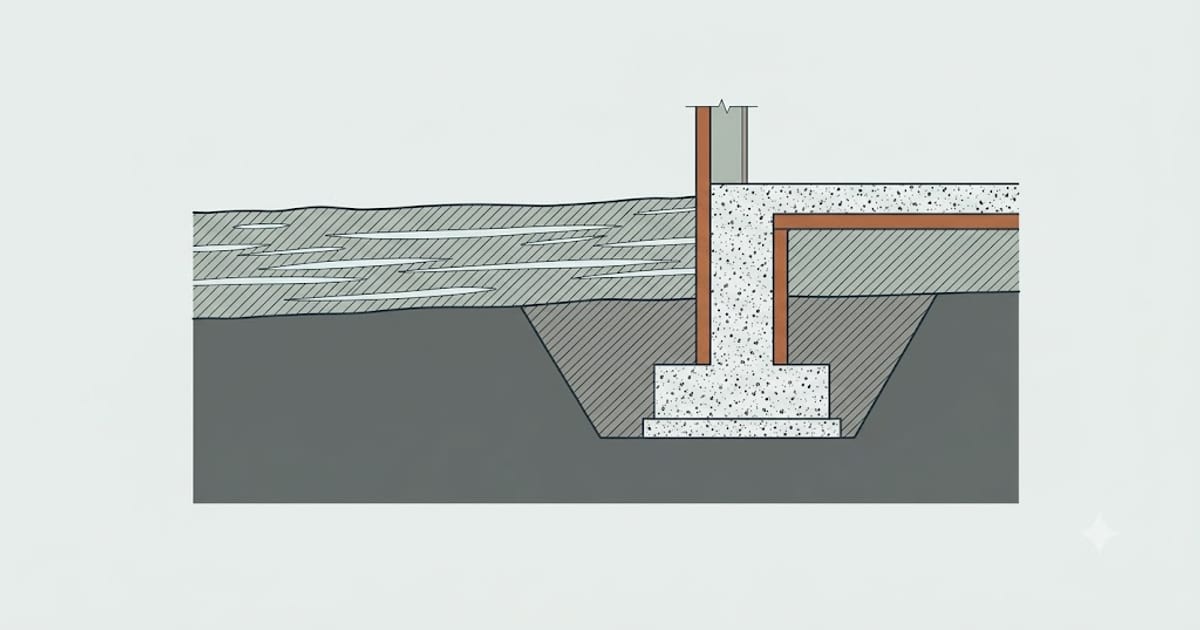 How Deep Should Footings Be? Frost Depth Decides, Not Load
Depth and diameter answer two completely different questions. Diameter is about carrying weight. Depth is about a force that has nothing to do with weight at all.
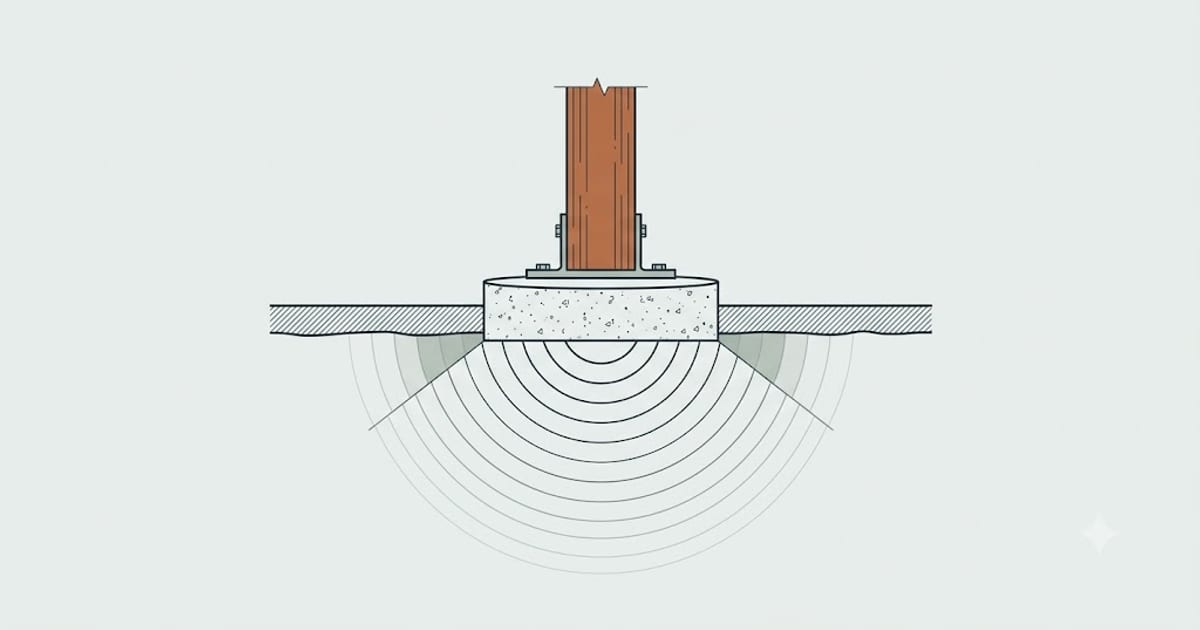 Footing Size for a Deck Post: Working Backwards from the Soil
Almost every deck footing question gets answered with "twelve inches" or "sixteen inches". Both are sometimes right and neither is an answer, because the number is decided by the ground, not by the post.