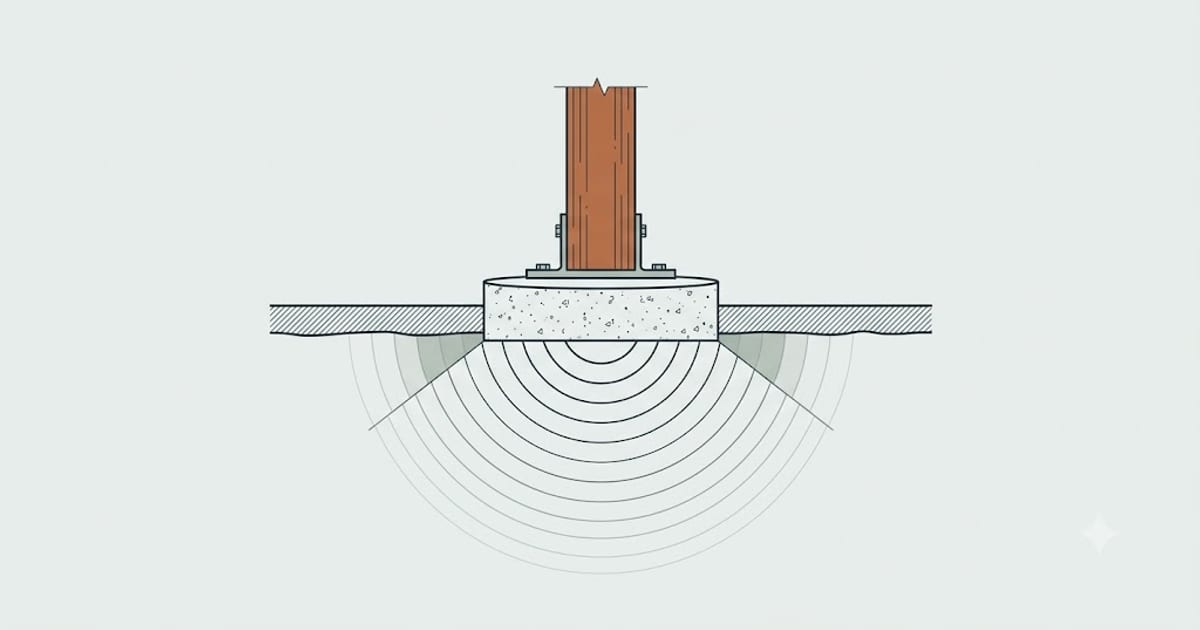
Ask how big a deck footing should be and you will be told twelve inches. Or sixteen. Both numbers are common, both are sometimes correct, and neither is an answer — because footing size is not a property of the post. It is a property of the soil.
A footing is a device for spreading a concentrated load over enough ground that the ground can carry it. Change the ground and the same deck needs a different footing.
The arithmetic, in three steps
Step one: tributary area. Each post carries the deck area closest to it — half the beam span each way, half the joist span each way. A post on a beam spanning 8 ft between posts, supporting joists spanning 12 ft, carries 8 × (12 ÷ 2) = 48 ft².
That "÷ 2" is where people go wrong. The joists run from the ledger to the beam, so the beam carries half their length and the house carries the other half.
Step two: load. The IRC uses 40 psf live plus 10 psf dead for residential decks — 50 psf total. Our 48 ft² post carries 2,400 lb.
Step three: divide by soil bearing capacity. This is the number nobody knows and everybody guesses.
| Soil | Presumptive bearing (IRC Table R401.4.1) |
|---|---|
| Crystalline bedrock | 12,000 psf |
| Sedimentary rock | 4,000 psf |
| Sandy gravel, gravel | 3,000 psf |
| Sand, silty sand, clayey sand | 2,000 psf |
| Clay, sandy clay, silty clay | 1,500 psf |
At 2,000 psf our 2,400 lb post needs 1.2 ft² of bearing — a 15-inch circle. At 1,500 psf it needs 1.6 ft², a 17-inch circle. On gravel, 12 inches is plenty.
Same deck. Same post. Three different footings, and the only thing that changed was the dirt.
Run your own numbers on the footing calculator — it does the tributary arithmetic and the soil division together, which is where the two-step version usually goes astray.
Depth is a different question, and it is not negotiable
Diameter handles bearing. Depth handles frost.
Water expands about 9% when it freezes. Soil holding water lifts as it freezes, and it lifts anything sitting in the frozen layer with it — a phenomenon called frost heave, and it is far stronger than a deck.
The bottom of the footing must sit below the local frost line. That depth is set by your building department, not by a national table: 0 in much of Florida, 42 inches across the northern Midwest, 48 or more in parts of Minnesota and Maine.
A footing poured to the correct diameter at insufficient depth will lift a deck several inches over a winter and drop it again in spring, opening the ledger connection a little more each cycle.
Two ways a correct footing still fails
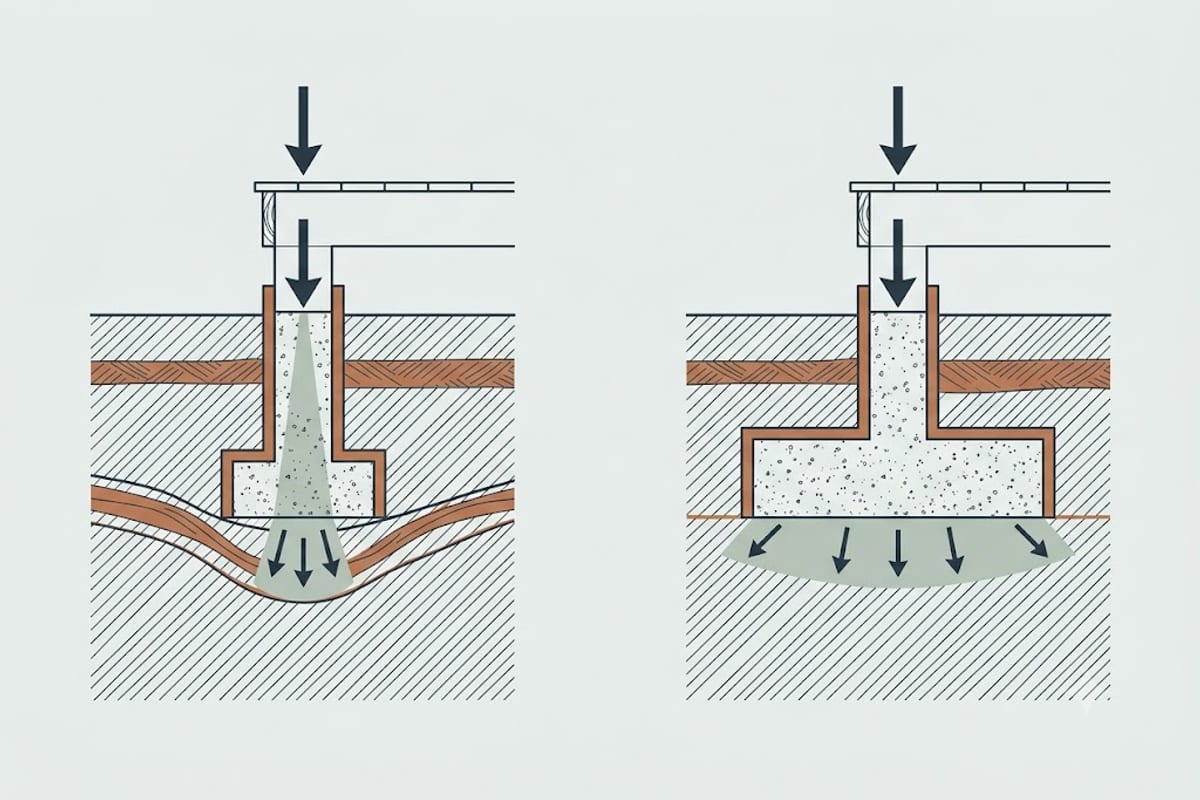
Bearing on disturbed soil. Auger a hole, and some of the spoil falls back in. Pour on top of that and the footing is bearing on loose fill, not on the undisturbed soil the table describes. Clean the bottom of the hole before the concrete goes in. Every time.
The flare that got cut off. A hole augered with a power auger comes out with a slight bell at the bottom. That bell is useful bearing area. A hole dug with a clamshell and then "tidied" square loses it.
What about a bigger footing than the table needs
It costs very little. A 16-inch hole instead of 12 is about 0.6 ft³ more concrete — one extra bag. Against the cost of jacking a deck to replace a footing, that is not a decision worth optimising.
Where extra diameter stops helping is at the post-to-footing connection. A large footing under a post attached with a nail or two transfers nothing; the connection fails first. Use a rated post base, anchored into the wet concrete or into the cured footing with the specified hardware.
The one thing this cannot tell you
Whether your soil is what you think it is. The IRC table gives presumptive values — presumed, not measured. A site with fill of unknown origin, a former pond, or a slope with any history of movement is a site where a soils engineer is cheaper than a rebuild.
If the auger comes up with anything soft, wet or organic below the surface, stop and find out what it is before pouring.