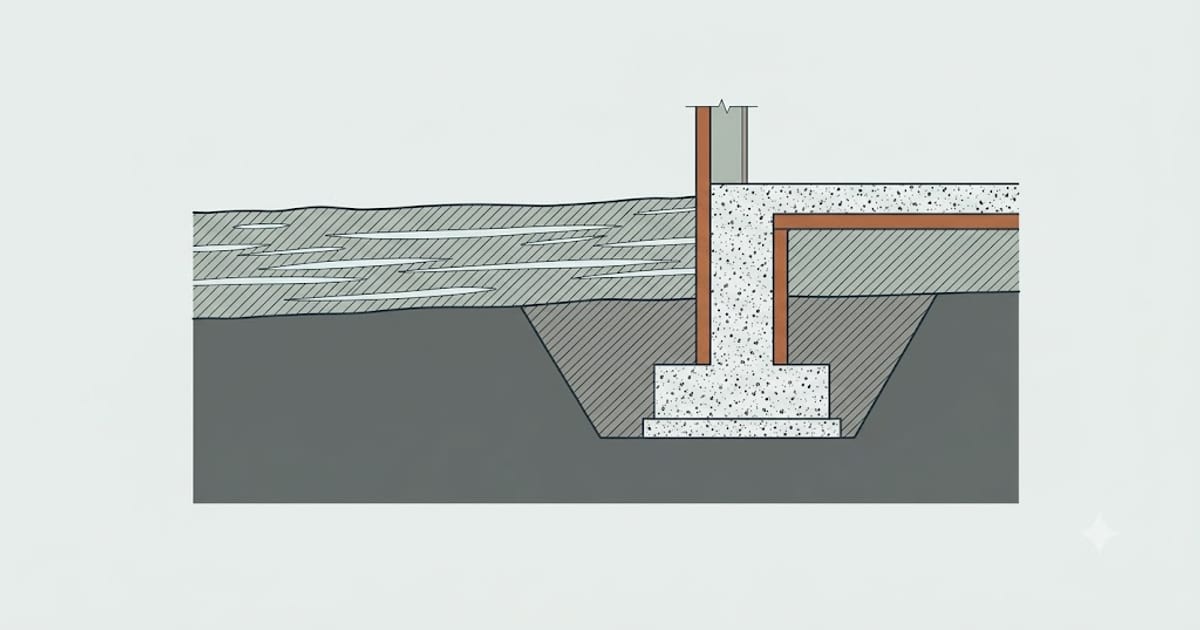
There are two dimensions to a footing and they answer different questions. Diameter decides whether the ground can carry the load. Depth decides whether winter can lift it.
Those are independent, and confusing them produces both of the classic mistakes: a wide shallow pad that heaves, and a deep narrow pier that settles.
Why frozen ground lifts concrete
Water expands about 9% on freezing. In soil that holds water, freezing does something worse than expand uniformly — it draws more water toward the freezing front, forming lenses of ice that grow perpendicular to the surface and push everything above them upward.
The pressures involved are enormous. Frost heave routinely lifts loaded foundations several inches. It is not a force you design against; it is a force you get below.
Below the frost line means below it
The requirement is that the bottom of the footing sits below the local frost depth, so no part of the bearing surface is in soil that freezes.
Frost depth is a local figure published by your building department. It ranges from zero across the Gulf Coast to 48 inches or more in northern Minnesota, Maine and the Dakotas. National maps are approximate and jurisdictions round upward; use the local number.
The IRC also sets a floor: 12 inches minimum below undisturbed ground surface, even where frost depth is nil. That covers erosion, surface disturbance and the fact that the top foot of soil is rarely as good as what is beneath it.
Four cases where the frost rule changes
Monolithic slabs in warm zones. A thickened-edge slab in a zero-frost region bears at the slab edge. The 12-inch minimum still applies.
Frost-protected shallow foundations. Rigid insulation extending horizontally from the foundation traps ground heat and raises the frost line locally. Engineered under ASCE 32, common in Scandinavia, permitted in the IRC for heated buildings. It works, and it needs a design — not a guess about how much foam to lay.
Unheated attached structures. A deck or porch attached to a heated house does not get the house's warmth. It needs full frost depth even though the wall beside it may not.
Rock. Bearing directly on sound bedrock removes the frost question — there is no soil to hold water. Bearing on a boulder is not the same as bearing on bedrock, and the distinction has ended a lot of decks.
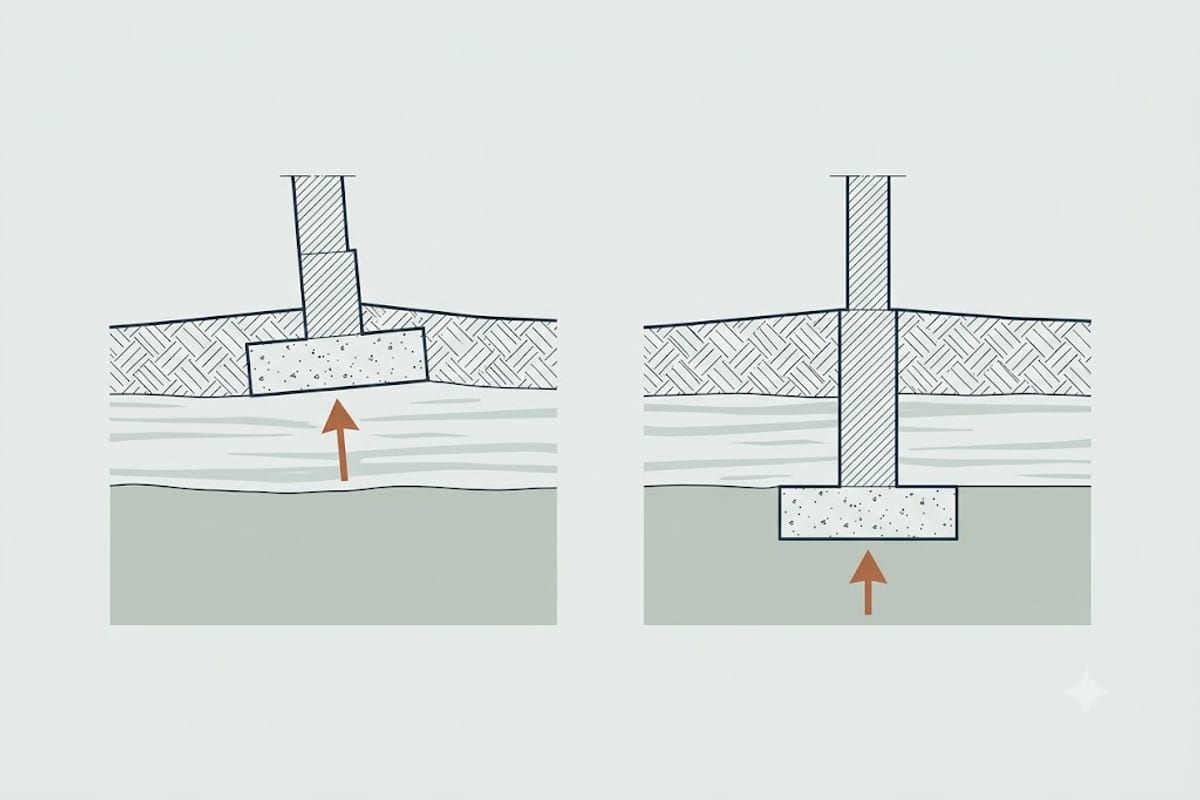
The mistake that survives correct depth
Digging to 42 inches and then backfilling loose soil before pouring. The concrete is now bearing at whatever depth the last undisturbed material sits at, which may be a foot higher than the hole is deep.
Pour against undisturbed soil at the bottom. If the hole is over-dug, fill with compacted gravel in lifts, not with the spoil.
Depth costs more than people budget
A 12-inch-diameter hole is 0.065 ft³ per inch of depth. Going from 24 to 42 inches on ten footings adds about 12 ft³ — roughly 20 bags of 80 lb mix, or a change in how you buy concrete entirely.
The post hole calculator works in the depth directly, which is worth doing before ordering rather than after the auger is on hire.
Where extra depth stops helping
Below frost, additional depth adds nothing to bearing — the soil at 60 inches is not meaningfully better than at 48 unless you are drilling to reach a firmer stratum, which is an engineered decision, not a default.
The exception is uplift. Tall narrow structures — sign posts, pergolas, fence posts in exposed positions — resist overturning partly through the depth of embedment, and there the extra depth is doing real work.