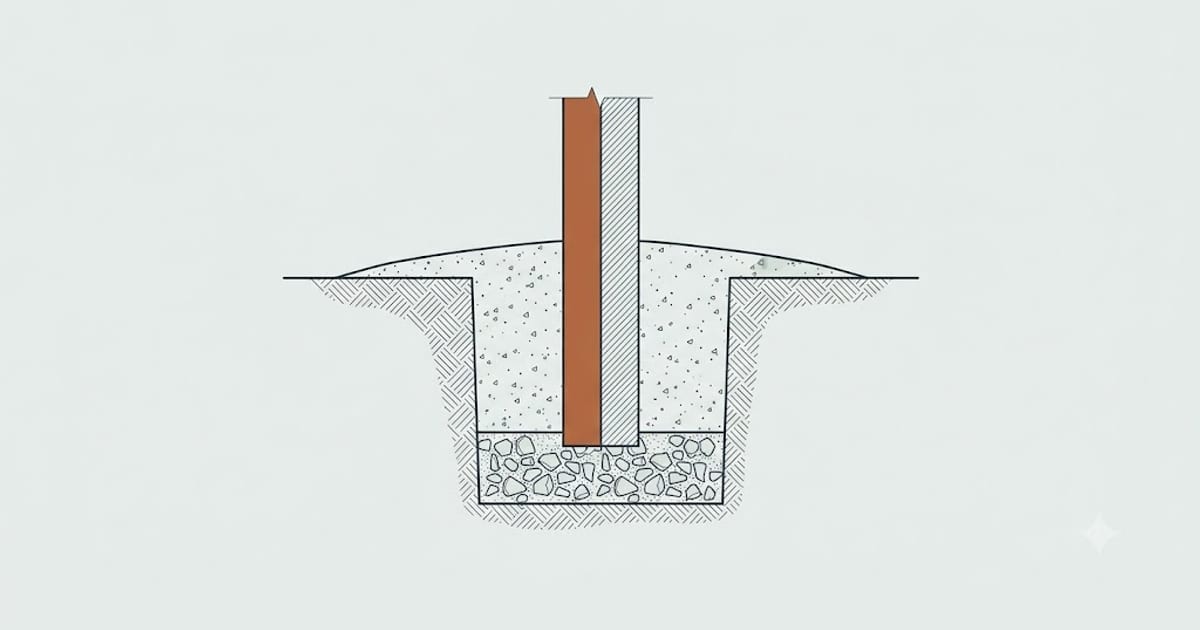
A fence post is not carrying weight. It is resisting overturning — wind pushing on the fence panel, levering the post out of the ground. That changes what the concrete is for and how much of it you need.
The two rules that set the hole
Depth: one third of the post above ground, plus a gravel base. A 6 ft fence needs 2 ft in the ground, so an 8 ft post. A 4 ft fence needs about 16 inches. Gate posts and end posts, which take more leverage, go deeper — a quarter more is the usual allowance.
Diameter: three times the post width. A 4 × 4 post (3½ inches actual) wants a 10 to 12 inch hole. A 6 × 6 wants 16 to 18.
Both rules exist because the concrete works by bearing against undisturbed soil over its whole face. A narrow collar concentrates the load and works the soil loose; a wide one spreads it.
And in frost country, depth is also set by the frost line. Below it, or the post ratchets its way upward one winter at a time.
Volume per hole
The hole volume less the post volume, in cubic feet:
| Hole | 24 in deep | 30 in deep | 36 in deep |
|---|---|---|---|
| 8 in dia. | 0.62 ft³ | 0.79 ft³ | 0.96 ft³ |
| 10 in dia. | 1.04 ft³ | 1.32 ft³ | 1.61 ft³ |
| 12 in dia. | 1.54 ft³ | 1.95 ft³ | 2.37 ft³ |
(4 × 4 post, actual 3.5 in.)
In bags, at 0.60 ft³ per 80 lb bag: a 10-inch hole at 30 inches deep takes about 2¼ bags. Twenty posts is 45 bags — a pallet, and a delivery decision rather than a car boot decision.
The post hole calculator takes the post size out of the hole volume properly, which the round-number tables usually skip. On a small hole the post is a tenth of the volume.
Fast-setting mix, poured dry
This is the one application where pouring concrete dry into the hole and adding water on top is correct. Fast-setting mixes are formulated for it, the bag says to do it, and it sets in 20 to 40 minutes.
It works here because the concrete is not a structural element in compression. It is a collar resisting lateral load, and the uneven hydration that would ruin a slab does not matter.
Do not extend the technique to footings, piers or anything carrying weight. Dry-poured concrete does not reach its rated strength and never will.
Gravel at the bottom, every time
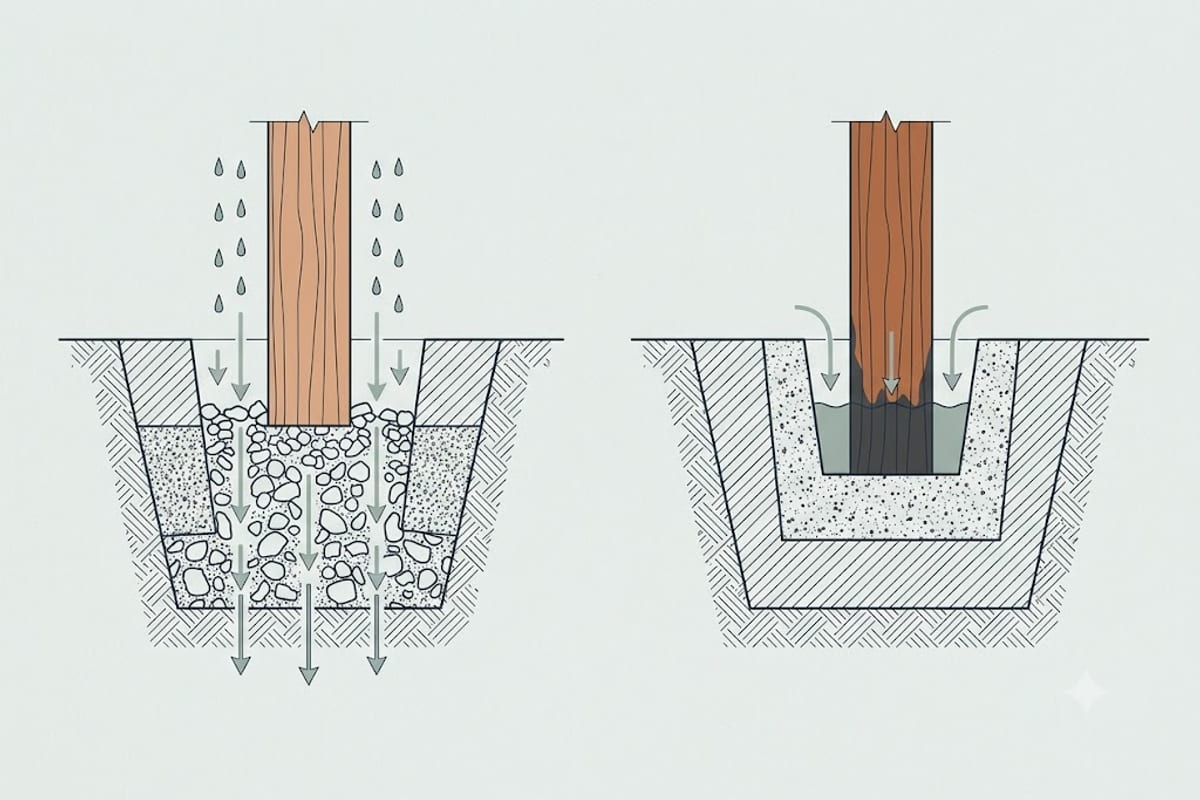
Four to six inches of compacted gravel under the post, and the post sitting on it rather than on concrete.
The reason is drainage. A post encased top to bottom in concrete sits in a bucket — water gets in around the top and has nowhere to go. Wood posts rot from the base up, and the rot happens exactly at ground level where you cannot see it until the fence leans.
Crown the top
Slope the concrete away from the post at the surface, an inch or so above grade. Water that pools against the post at the concrete line is the second most common cause of base rot after the missing gravel.
When not to use concrete at all
Compacted gravel alone holds fence posts well in well-drained soil, drains freely, and lets you pull a post without excavating a block of concrete. It is standard practice in parts of the country and it works.
Post anchors driven into the ground are fast and fine for light fencing on good soil. They do not match a concreted post for a tall privacy fence in wind.
The case for concrete is strongest where soil is soft, the fence is tall, or the post is a gate post. Gate posts move if there is any doubt at all — set those in concrete, oversized, and deeper.