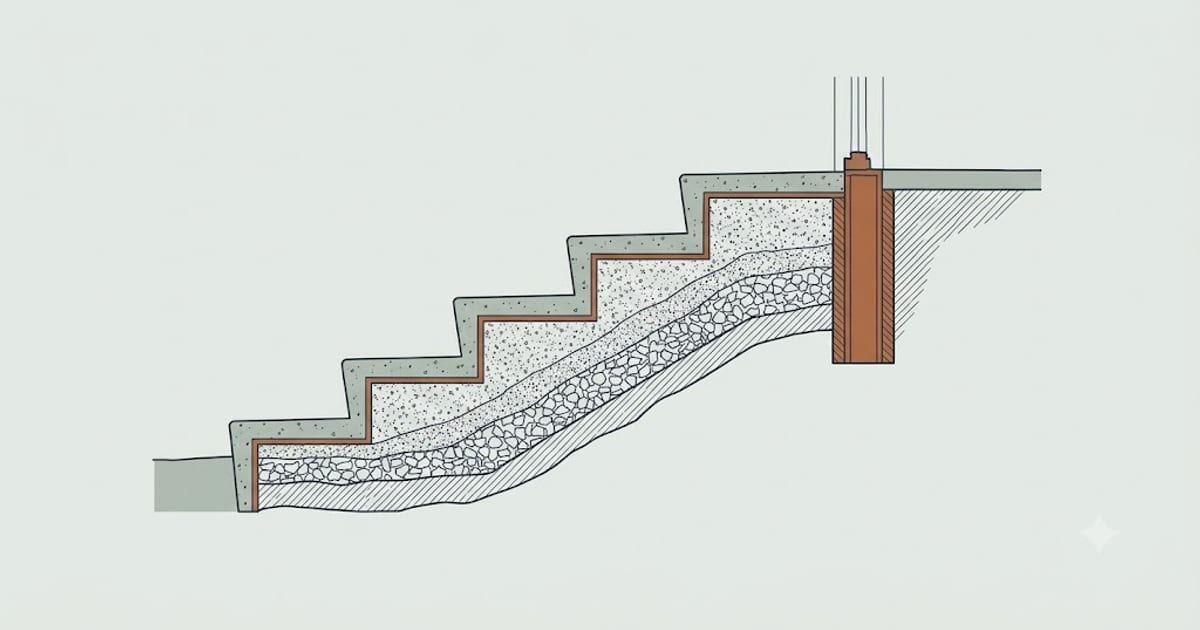
Most concrete calculations start with dimensions you choose. Steps do not. The total rise — finished floor to finished grade — is fixed by the building, and everything else is derived from it.
Start by dividing the rise
Measure the total rise. Divide by the maximum riser height the code allows, round up to a whole number, then divide the rise by that number to get the actual riser.
Total rise 36 inches, maximum riser 7¾: 36 ÷ 7.75 = 4.65, so 5 risers, each 7.2 inches.
All five must be 7.2. Not four at 7 and one at 7.8.
The code, and the tolerance that catches people
IRC R311.7.5 for residential stairs:
- Maximum riser height 7¾ inches
- Minimum tread depth 10 inches
- Maximum variation between the largest and smallest riser in a flight: ⅜ inch
That last one is the one that fails inspections. It is not a guideline — it is a measured tolerance, and it exists because people trip on the odd step. The foot learns the rhythm of a stair within two treads and a riser that differs by half an inch is precisely the kind of trap that causes falls.
For a concrete flight, unequal risers usually come from a top step poured to the wrong height or a bottom step cast on a landing that was not yet at final grade. Both are fixable on paper and not fixable in concrete.
Volume
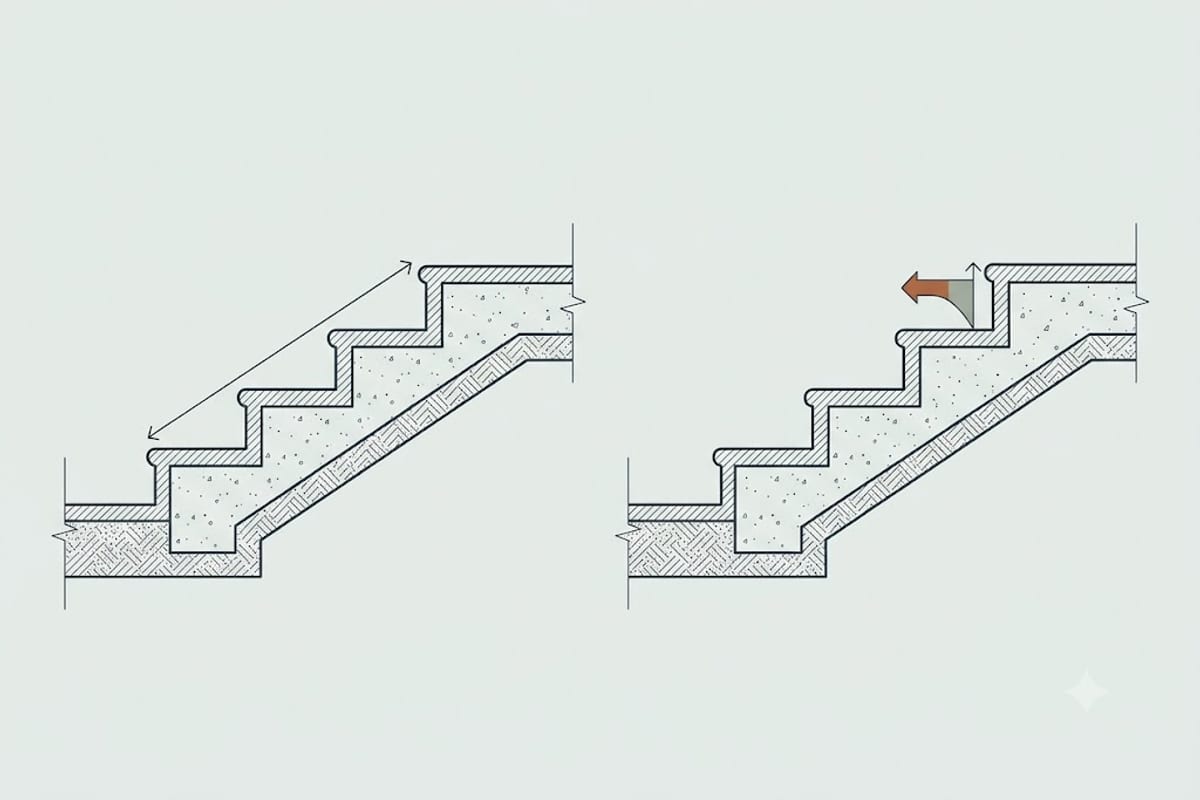
Steps form a stack of rectangular blocks. Each step's volume is width × tread depth × the height of concrete beneath it, and each successive step sits one riser higher.
For a flight of n steps at width w, tread t and riser r, the total is:
volume = w × t × r × n(n+1) ÷ 2
The n(n+1)/2 term is why a five-step flight is not five times a one-step flight — it is fifteen times. Steps grow fast.
Four steps, 48 inches wide, 11-inch tread, 7-inch riser: 4 × (11/12) × (7/12) × 10 = 21.4 ft³, about 0.8 cubic yards. That is already at the ready-mix crossover, and it is a small flight.
The steps calculator resolves the riser division and the volume together, including the fill allowance below.
Fill below, and why it is not cheating
Solid concrete steps are heavy, expensive and unnecessary. The bottom of the stack carries no load that a compacted fill core cannot carry.
Compacted gravel fill under the lower steps, with a 5 to 6 inch concrete shell over it, is standard practice. It cuts volume substantially — often by a third on a taller flight — and behaves the same.
What matters is that the fill is compacted in lifts, and that the shell thickness is maintained at the nose of every tread, which is where the load and the abrasion are.
The details that decide how they look in ten years
Slope the treads ¼ inch per foot forward so water runs off. Flat treads hold water, and water plus freeze-thaw takes the nose off first.
Air entrainment for any exterior steps in a freezing climate. 5 to 7%. Steps get the worst of everything — salt, snow shovels, freeze-thaw — and un-entrained concrete scales within a few winters.
Round the nose. A sharp arris chips. An edging tool takes thirty seconds per tread.
Handrails. Required on four or more risers. If a rail is going to be anchored into the concrete, set the sleeves or anchors in the wet pour. Drilling into a cured tread near the edge is how treads crack.
Forms take longer than the pour
The form work for a flight of steps is most of the labour and all of the accuracy. Brace the riser boards hard — wet concrete pushes them outward and a bowed riser board gives a tread deeper at the middle than at the ends.
Bevel the bottom edge of each riser board so a float can reach the back of the tread below. Without it, the back of each tread cannot be finished.