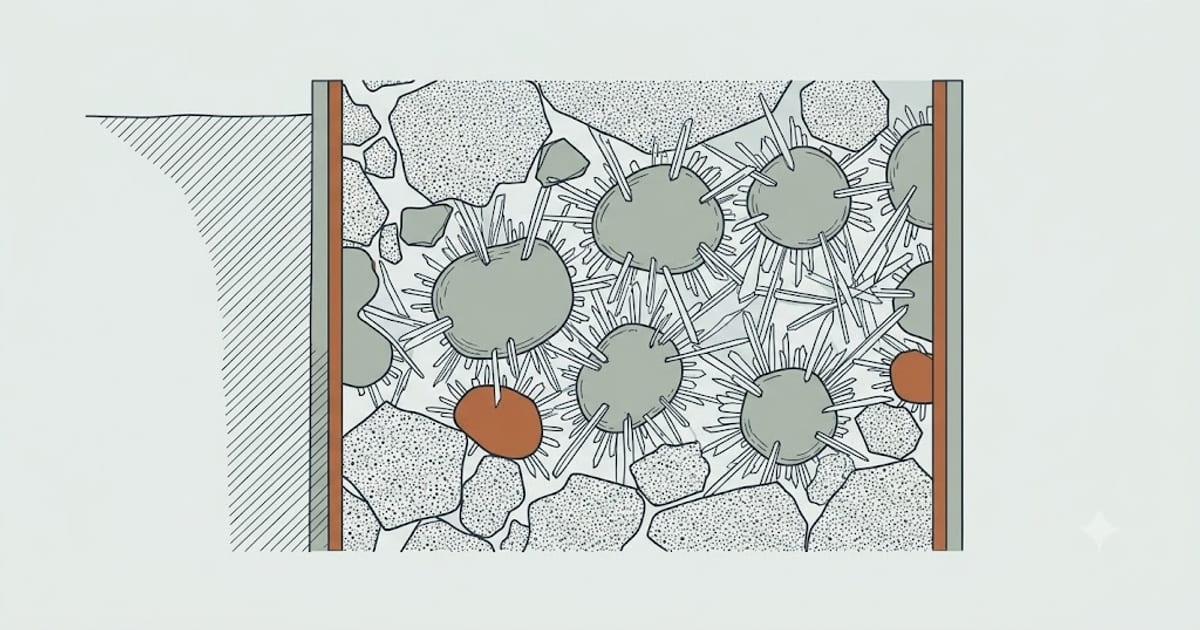
Concrete does not dry out. It hydrates — cement reacts chemically with water to form the crystals that give it strength. Water is a reagent, not a solvent, and the reaction continues for years as long as water is available.
That single fact explains everything confusing about curing, including why concrete gains strength underwater and why letting it dry in the sun ruins it.
Three timescales, routinely confused
Initial set: 4 to 8 hours. The mix stiffens and no longer flows. Finishing must be done before this. Ambient temperature moves it substantially — a hot afternoon can halve it.
Final set: 24 to 48 hours. Firm enough to walk on carefully. Forms on vertical work can come off. Anything heavier stays off.
Design strength: 28 days. The reference point for all specified strengths. Not a finish line — concrete keeps gaining strength for years, just more slowly.
Useful milestones along the way:
| Age | Approximate share of 28-day strength |
|---|---|
| 1 day | 15% |
| 3 days | 40% |
| 7 days | 65% |
| 14 days | 85% |
| 28 days | 100% |
| 1 year | 115–125% |
What you can do when
- 24 hours — foot traffic, carefully. No wheelbarrows.
- 3 days — light foot traffic, furniture.
- 7 days — a car, if the slab is designed for it. Most professional guidance says wait.
- 28 days — heavy vehicles, full service load.
Driving on a 7-day driveway is not an immediate failure; it uses up margin that was supposed to be there for the next twenty years.
Keeping it wet is the whole job
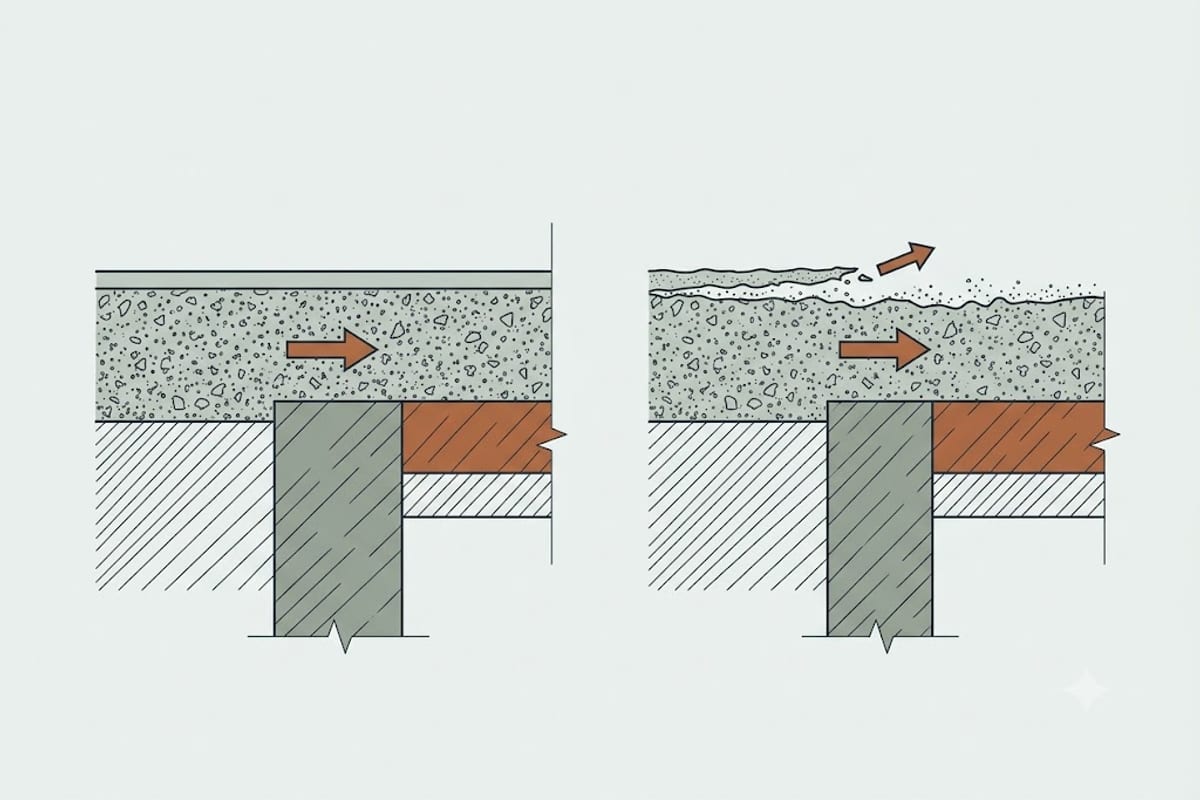
The single largest controllable factor in finished strength is whether the surface stays moist for the first seven days. Concrete that dries early stops hydrating at the surface, and the surface is exactly where you need strength — it takes the abrasion, the freeze-thaw and the de-icing salt.
Poorly cured concrete can lose 30 to 50% of its potential surface strength. It shows up as dusting, scaling and premature surface wear, and it cannot be fixed afterwards.
Methods, in rough order of effectiveness for small pours:
- Ponding or continuous wetting — best, impractical on anything but a small flat slab.
- Wet burlap under plastic — very effective, needs re-wetting.
- Plastic sheeting — good, but it mottles the colour where it touches unevenly.
- Curing compound — spray-applied membrane, easiest at scale, and the standard on commercial work.
Seven days is the usual target. In cold weather, longer — hydration slows with temperature and effectively stops below about 5 °C.
Temperature at both ends
Hot. Above about 30 °C the mix sets fast, bleed water evaporates faster than it rises, and plastic shrinkage cracks open across the surface within hours. Pour early, dampen the sub-base, and start curing immediately.
Cold. Below 5 °C hydration crawls. Below freezing, water in the mix turns to ice and expands, disrupting the paste permanently — concrete frozen before it reaches about 500 psi is damaged beyond repair. Blankets, heated enclosures, or do not pour.
Sealing is not curing
A sealer applied at 28 days protects the surface from water and salt. A curing compound applied at hours protects the hydration reaction. They are different products doing different jobs at different times, and applying a sealer to green concrete traps moisture and can cause blistering.
The practical version
Cover it, keep it wet for a week, and stay off it. Everything else about curing is refinement on those three.