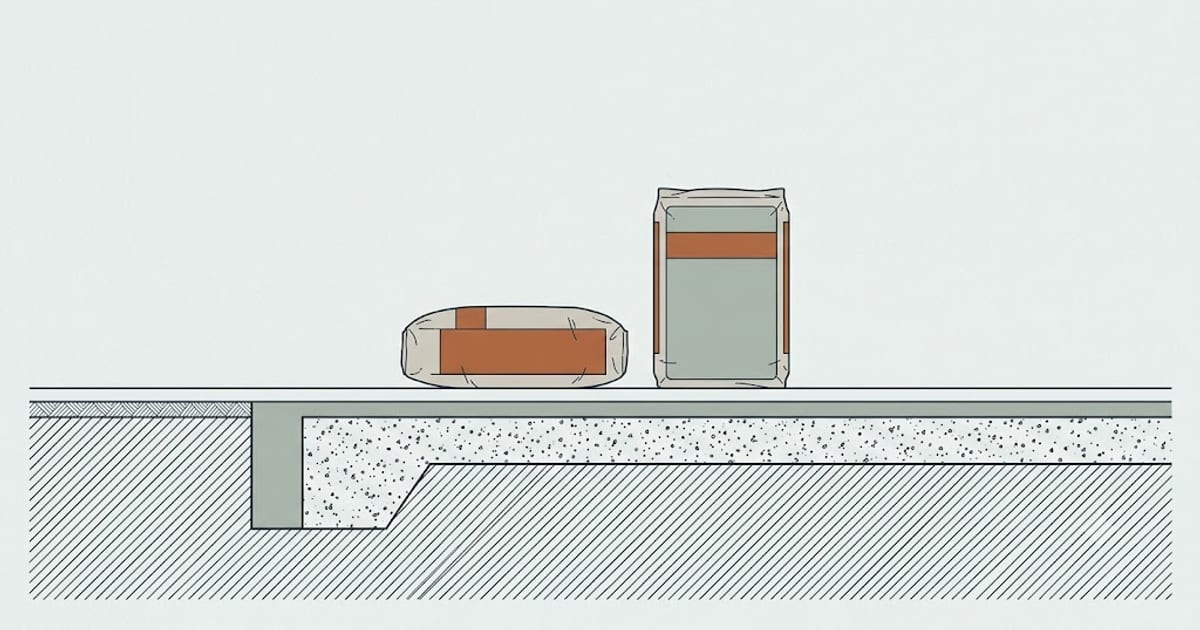
The yields are printed on the bags and the ratio between them is exact:
| 60 lb | 80 lb | |
|---|---|---|
| Yield | 0.45 ft³ | 0.60 ft³ |
| Bags per cubic yard | 60 | 45 |
| Bags per 10 ft³ | 23 | 17 |
An 80 lb bag holds exactly one third more than a 60. So 33% more bags, each 25% lighter — which is the trade in one line.
Cost usually favours the 80
Per cubic foot, the larger bag is normally cheaper. The reasons are packaging and handling: same paper, same pallet space per unit volume, fewer units to move through the supply chain.
The margin is not dramatic — often in the range of 5 to 15% per cubic foot — but on anything past a few dozen bags it is real money, and it points one way.
Check it yourself at your own supplier rather than trusting the general rule: divide the price by the yield, not by the weight. Price per pound is the wrong comparison because you are not buying pounds, you are buying volume.
Handling is what actually decides it
An 80 lb bag is a genuinely awkward lift. Repeated forty-five times, from a pallet into a vehicle, out again, and across a site, it is the kind of work that ends projects early or ends them with a back injury.
The questions that decide it:
- How far from the vehicle to the pour? Long carries favour 60 lb bags heavily.
- Are there stairs, or soft ground? Same answer, more so.
- Is anyone helping? One person alone should think hard before choosing 80.
- Is there a wheelbarrow and a clear route? If yes, 80 lb becomes reasonable again.
Nobody regrets the smaller bag at the end of a long carry, and the price difference across a small project is often less than the cost of one wasted afternoon.
The mixer capacity limit
This one is specific and it surprises people.
A portable mixer's rated drum volume is not its working volume. Concrete needs room to tumble — that is the entire mechanism by which it mixes — so a drum filled to capacity simply rolls the material without folding it, and the mix comes out inconsistent.
The usable fraction is roughly half to two-thirds of the rated drum size. On a common small mixer that means one 80 lb bag per batch, or occasionally two 60 lb bags.
If your mixer takes a single 80 lb bag per batch, then 45 bags is 45 batches. With 60 lb bags at two per batch, the same yard is 30 batches. The smaller bag can genuinely be faster despite there being more of them — which inverts the intuition entirely.
Check your drum's rated volume and work from there rather than from the bag.
Which to buy
- Small job, short carry, mixing in a wheelbarrow — 80 lb. Fewer bags to open, slightly cheaper.
- Long carry, stairs, working alone, or over about 20 bags — 60 lb.
- Using a mixer — work out batches per bag size first; that number may decide it against the price.
- Over about a yard — the question is moot. See bags in a yard for where ready-mix takes over.
FAQ
Is an 80 lb bag of concrete cheaper than a 60?
Per cubic foot, usually yes, by roughly 5 to 15%. Compare price divided by yield rather than price divided by weight.
How many 60 lb bags equal an 80 lb bag?
One and a third. A 60 yields 0.45 cubic feet against 0.60 for an 80.
How many bags fit in a concrete mixer?
Usually one 80 lb bag or two 60 lb bags per batch on a small portable mixer. Working volume is only about half to two-thirds of the rated drum size, because the mix needs room to tumble.
Which bag size should I buy for a fence post?
Either — a post hole takes so few bags that handling and price barely differ. Buy whichever your supplier has.