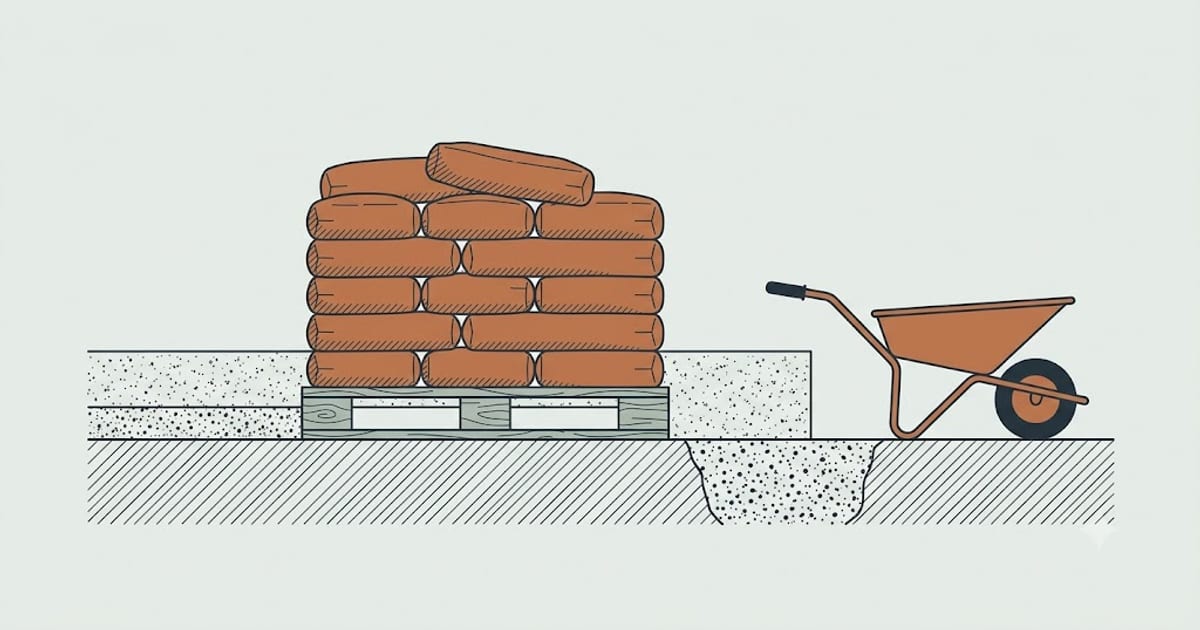
One cubic yard is 27 cubic feet. Every bag prints its yield on the front. The division is the whole calculation:
| Bag | Yield | Bags per yard |
|---|---|---|
| 80 lb | 0.60 ft³ | 45 |
| 60 lb | 0.45 ft³ | 60 |
| 50 lb | 0.375 ft³ | 72 |
| 40 lb | 0.30 ft³ | 90 |
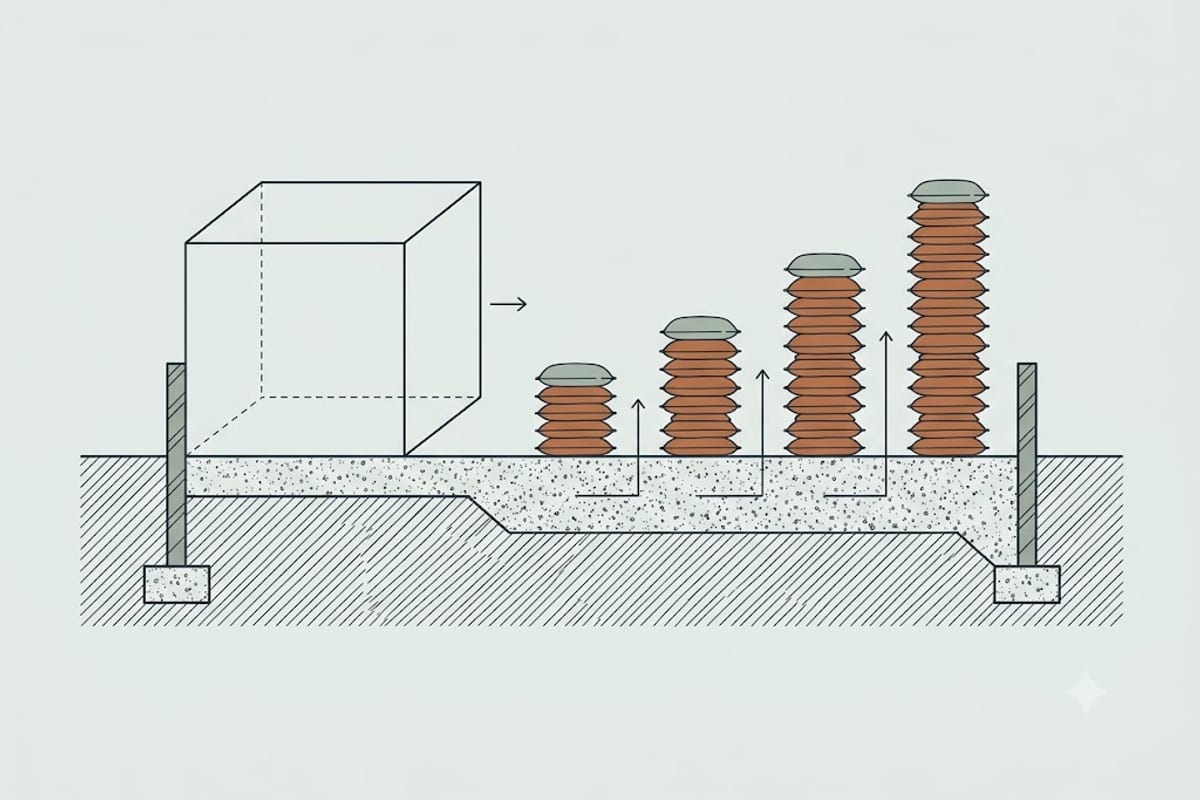
Those are yields for standard concrete mix. Fast-setting and high-strength blends yield slightly differently, and the number on your bag beats the number on this page.
What 45 bags actually means
The arithmetic is easy and it hides the decision. Forty-five 80 lb bags is 3,600 pounds of material — to buy, to move into a vehicle, out of a vehicle, and to the pour. A typical half-ton pickup is at its payload limit before the pallet is full.
Then it has to be mixed. A yard in bags is not an afternoon; it is a full day with a mixer and help, and the pour has to stay continuous or you get cold joints between batches.
That last point is the one people discover too late. Concrete poured against concrete that has already begun to set does not become one slab. It becomes two, with a weak line between them. Mixing a yard by hand in sequence is a race against your own first batch.
Where ready-mix wins
Ready-mix arrives wet, mixed correctly, in one continuous pour.
Roughly, bagged concrete at typical retail runs somewhere near $250–$300 per cubic yard in material alone. Ready-mix commonly runs $150–$200 per yard before fees — but small orders carry a short-load fee, usually applied under about 3 to 5 yards, and that fee is what decides the comparison at small volumes.
The practical shape of it:
- Under about ⅓ yard (9 ft³, roughly 15 bags) — bags, comfortably. Post holes, small pads, steps.
- ⅓ to 1 yard — genuinely arguable. Bags if you have time and help; ready-mix if the pour must be continuous.
- Over 1 yard — ready-mix, nearly always. Even with the short-load fee, you are ahead on money, hours and quality.
- Over 3 yards — ready-mix without discussion.
Do not round down
Whichever route you take, buy more than the calculation says. The arithmetic assumes a perfectly formed void and perfectly used material, and neither exists:
- Sub-grade is never flat. Low spots take more.
- Forms bulge slightly under wet concrete.
- Spillage, what stays in the mixer, and what stays in the wheelbarrow.
Add 10% for a slab on prepared ground, and more on rough or uneven sub-grade. Running out mid-pour is the failure that cannot be repaired afterwards — a second batch mixed twenty minutes later is a cold joint, not a slab. Two spare bags cost less than any of the alternatives.
The reverse mistake is cheap: leftover bags keep for months if stored dry and off the ground.
Working from your own project
Start from volume in cubic feet, then divide:
Slab: length × width × (thickness in inches ÷ 12). A 10 × 10 ft slab at 4 inches is 10 × 10 × 0.333 = 33.3 ft³ = 1.23 yards = 56 bags at 80 lb.
That example is exactly the size where the decision tips. Fifty-six bags is 4,480 pounds and a long day; 1.5 yards delivered is one truck and an hour.
Details for specific shapes: concrete for a slab, fence posts, and round piers.
FAQ
How many 80 lb bags of concrete make a yard?
Forty-five. An 80 lb bag yields 0.60 cubic feet and a cubic yard is 27 cubic feet.
How many 60 lb bags in a yard?
Sixty, at 0.45 cubic feet per bag.
Is it cheaper to buy bags or ready-mix?
Ready-mix is cheaper per yard, but small orders carry a short-load fee. Bags usually win below about a third of a yard; ready-mix wins above one yard even with the fee.
How much concrete do I need for a 10x10 slab?
At 4 inches thick, 33.3 cubic feet — about 1.23 cubic yards, or 56 bags at 80 lb. Add 10% for waste.
What happens if I run out of concrete mid-pour?
You get a cold joint: the second batch does not bond properly to the first, leaving a weak line through the slab. This cannot be fixed afterwards, which is why you buy extra rather than exactly enough.