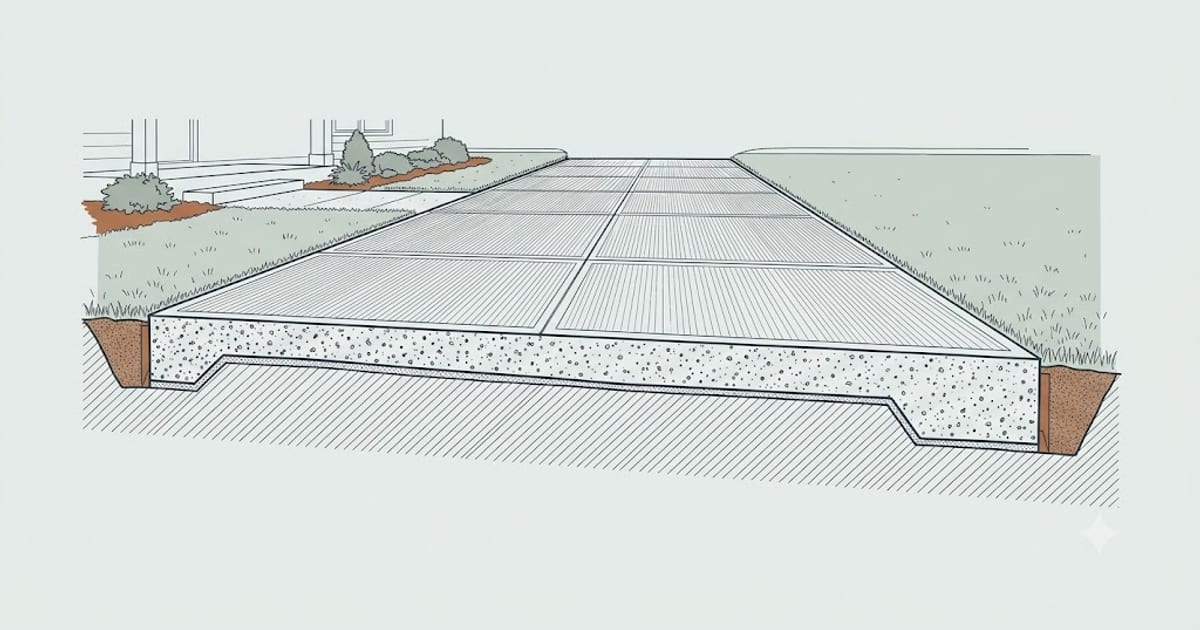
PSI is compressive strength — how much pressure the concrete withstands before crushing — measured on a test cylinder at 28 days.
That last part matters. Concrete specified at 4,000 psi is not 4,000 psi on day three. It reaches roughly 70% of its rated strength at 7 days and the rated figure at 28.
By application
| Use | PSI |
|---|---|
| Footings, foundation walls (residential) | 2,500–3,000 |
| Sidewalks, patios | 3,000–3,500 |
| Driveways | 3,500–4,000 |
| Garage floors | 4,000 |
| Freeze-thaw exposure, any of the above | 4,000 + air entrainment |
Most bagged concrete mix reaches around 4,000 psi at 28 days, which is why bag-mixed residential work rarely has a strength problem. The problems come from elsewhere.
Stronger is not automatically better
Higher PSI means more cement in the mix. More cement means more shrinkage as the concrete cures, and shrinkage is what cracks slabs.
Specifying 5,000 psi for a patio does not buy a better patio. It buys a slightly more crack-prone one, at higher cost, for strength nobody will ever load. The published figures above are not conservative minimums to be exceeded — they are the range where strength and shrinkage balance for that use.
What genuinely improves a slab is more mundane: adequate thickness, a compacted base, control joints at the right spacing, and enough reinforcement.
In freezing climates, air entrainment beats PSI
This is the specification that actually decides whether an exterior slab survives northern winters, and it is not a strength number.
Air entrainment deliberately introduces microscopic air bubbles — typically 5–7% by volume. Water that penetrates the concrete expands about 9% when it freezes, and without somewhere to expand into, it spalls the surface off. The bubbles give it that space.
A 4,000 psi slab without entrained air will scale and flake at the surface after a few freeze-thaw winters. A 3,500 psi slab with proper air entrainment will not.
Ready-mix suppliers add it on request and it costs little. Ask for it by name on any exterior pour in a freezing climate — it will not be there by default unless the plant knows the pour is exterior.
Note that air entrainment slightly reduces compressive strength, which is one more reason the two specifications have to be considered together rather than maximising one.
What to tell the ready-mix plant
Give them the use, not just a number. A useful order sounds like:
"Exterior driveway, 4 inches, freeze-thaw climate — 4,000 psi, air entrained 5–7%, 4-inch slump."
Slump is workability, and it is where the mix gets quietly ruined. A stiffer mix is stronger; anyone adding water on site to make placing easier is trading strength for convenience. That trade is covered in how much water per bag, and the same arithmetic applies to a truck.
For bagged work, the PSI is whatever the bag says and your control is the water. Do not add more than the bag calls for.
FAQ
What PSI concrete for a driveway?
3,500 to 4,000 psi. In freeze-thaw climates use 4,000 with 5–7% air entrainment.
Is higher PSI concrete better?
Not necessarily. Higher strength means more cement and more shrinkage, which increases cracking. Match the specification to the use.
What PSI is bagged concrete mix?
Most standard bagged mixes reach about 4,000 psi at 28 days, which covers ordinary residential work.
When does concrete reach its rated PSI?
At 28 days. It reaches roughly 70% of the rated figure at 7 days.
What is air entrainment and do I need it?
Microscopic air bubbles, typically 5–7%, that give freezing water room to expand. Essential for any exterior slab in a freeze-thaw climate and more important than the strength figure.