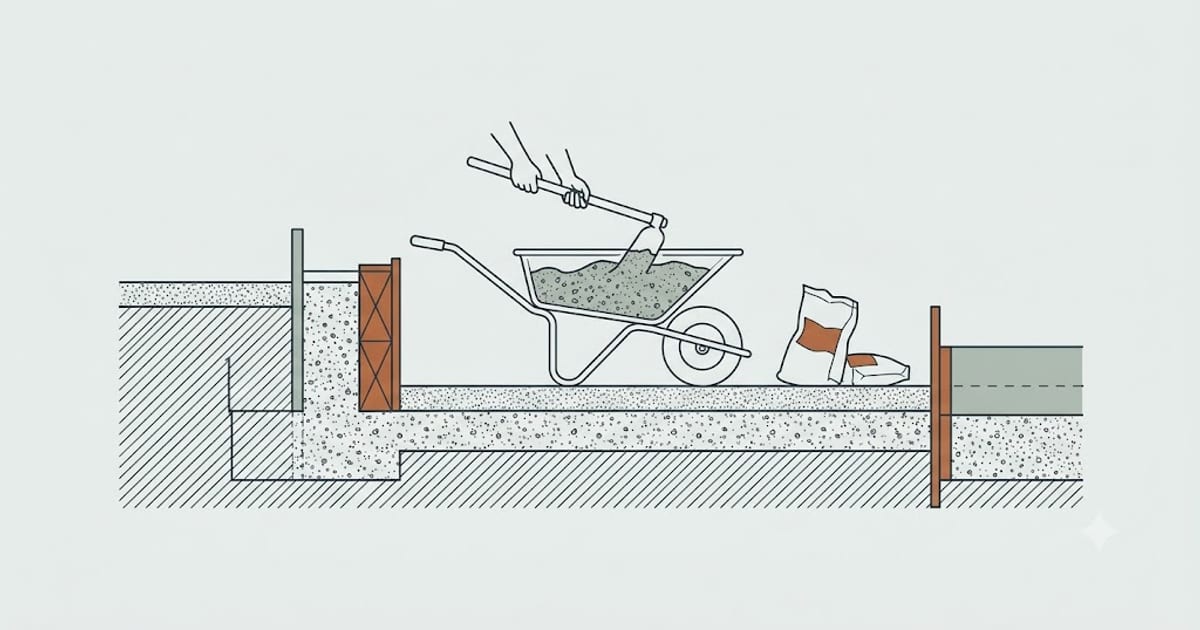
Approximate water per bag of standard concrete mix:
| Bag | Water |
|---|---|
| 80 lb | ~3 quarts (6 pints) |
| 60 lb | ~2.5 quarts (5 pints) |
| 40 lb | ~1.5–2 quarts |
Take the figure on your own bag over these — it varies with the mix, and fast-setting blends differ noticeably.
Treat the printed number as a maximum, not a target. Start with about 90% of it, mix, and add the rest only if needed.
Why extra water is not free
Cement needs a specific amount of water to hydrate — chemically about 0.25 parts by weight, and practically around 0.45 to 0.60 to also be workable.
Anything beyond that does not react. It sits in the mix, and when it eventually evaporates it leaves a void behind. Voids are where strength was supposed to be.
The effect is not marginal. Moving the water-cement ratio from 0.45 to 0.65 can cost roughly a third of the compressive strength — from the same bag, the same aggregate, the same everything. A 4,000 psi mix becomes something closer to 2,700.
This is the single most common way good material produces a bad slab: the mix looked stiff, somebody added water to make it easier to place, and the strength left with the bleed water.
Judging consistency without a slump cone
Professionals measure slump with a cone. On site with a wheelbarrow, three checks get close enough:
It holds a ridge. Draw the hoe through the mix. The furrow should stand rather than flow back together. If it closes up, there is too much water.
It sticks to the trowel briefly, then releases. Concrete that slides straight off is wet. Concrete that will not release at all is dry.
A handful squeezes into a ball that keeps its shape without water running out between your fingers.
The mix should look slightly stiffer than you want. It will feel easier once it is in the form and being worked, and it is far easier to add a little water than to take it out.
If it is genuinely too stiff to place
The answer is not the hose. Options that do not cost strength:
- A plasticizer or water-reducing admixture — improves workability at the same water content. This is what ready-mix plants use.
- Smaller aggregate for tight forms or heavily reinforced sections.
- Mix smaller batches and place them faster, so the mix has less time to stiffen before it is worked.
- Damp the forms and subgrade first. Dry ground and dry timber pull water out of the mix from below and behind, which stiffens it while also starving the cure.
Temperature changes the working time, not the water
Hot weather makes concrete set faster, and the instinct is to add water to keep it workable. That trades permanent strength for temporary convenience.
Pour early in the morning, dampen everything beforehand, and have the covering ready before the pour rather than after. Cold has the opposite effect — slow set, long finishing waits, and its own threshold covered in pouring in cold weather.
FAQ
How much water for an 80 lb bag of concrete?
About 3 quarts, but check the bag. Start with roughly 90% of the printed figure and add the rest only if the mix needs it.
What happens if you add too much water to concrete?
The excess does not react with the cement. It evaporates and leaves voids, which can cost about a third of the compressive strength.
How do I know if concrete is too wet?
Draw a hoe through it. If the furrow flows back together instead of holding its shape, there is too much water.
Can I add water after mixing?
A small amount in the first minutes, yes. Once the concrete has begun to set, adding water breaks the developing structure and does permanent damage.
What is the correct water-cement ratio?
Around 0.45 to 0.60 by weight. Below that it is unworkable; above it, strength falls off quickly.