Gravel is calculated in cubic yards and sold by the ton. Any calculation that stops at yards has stopped one step short of the number on the invoice.
Weights per cubic yard
The conversion is different for every material, and the differences are large enough to matter on a full load:
| Material | lb per yd³ | tons per yd³ |
|---|---|---|
| #57 crushed stone | 2,700 | 1.35 |
| Crusher run / road base | 2,800 | 1.40 |
| Pea gravel | 2,700 | 1.35 |
| River rock | 2,600 | 1.30 |
| #8 stone (pea-size crushed) | 2,700 | 1.35 |
| Masonry sand | 2,700 | 1.35 |
| Screened topsoil | 2,000 | 1.00 |
These are dry, loose figures. Stone stockpiled outdoors after rain runs up to 10% heavier, and the quarry weighs what it loads — including the water.
Depth by application
| Use | Depth |
|---|---|
| Decorative beds | 2 in |
| Walkways | 3 in |
| Paver base, pedestrian | 4 in |
| French drain / drainage bed | 4 in |
| Driveway base, cars | 6 in |
| Driveway base, soft or filled ground | 8 in |
Depth matters more than material choice. A driveway base at 3 inches fails whatever stone is in it, and no amount of surface stone rescues it.
Compaction is a property of the material
Base materials — crusher run, #21A, road base — are angular with fines, and they lose roughly 20% of their loose volume under a plate compactor. Order the finished compacted volume and you will be short by exactly that, on the day, with the compactor already on hire.
Decorative stone is never compacted. Adding a base allowance to river rock is the same mistake in the opposite direction: a pile you cannot use and did not need.
The gravel calculator applies the compaction factor only to materials that get compacted, which is the distinction most round-number tables miss.
Compact in lifts
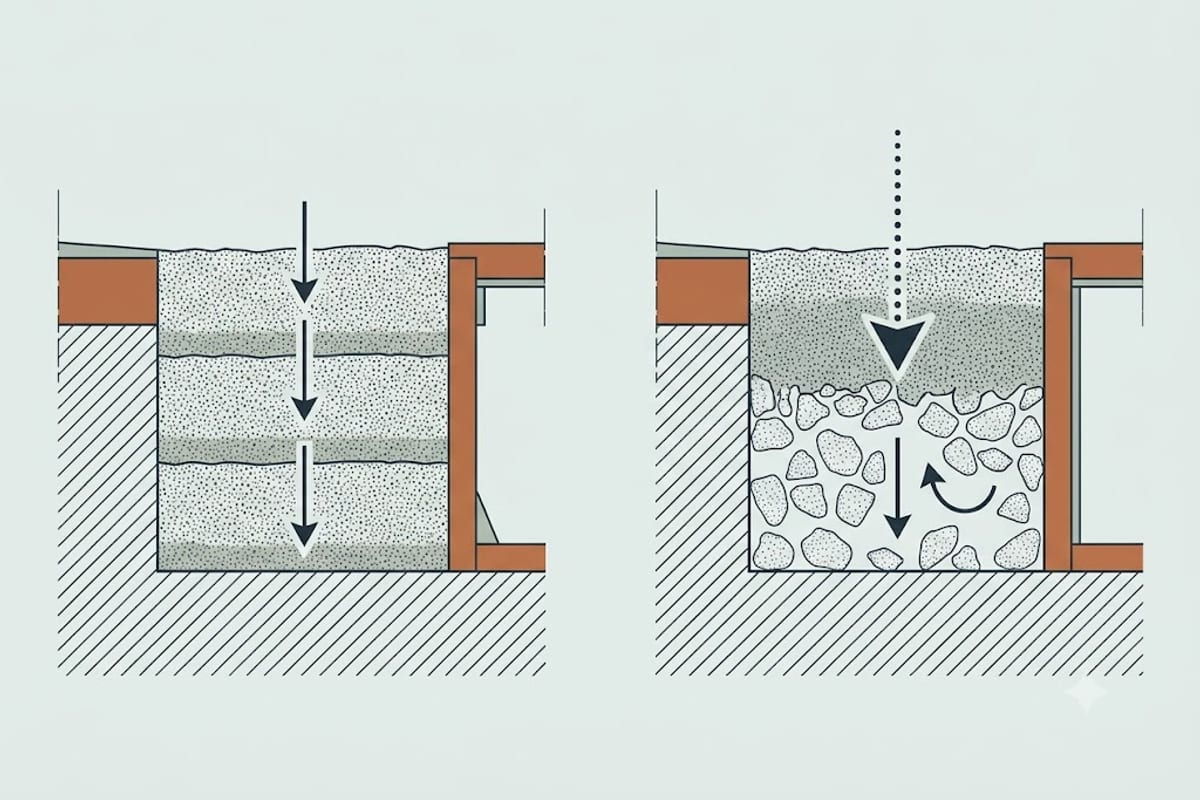
No more than four inches at a time, wet slightly, and compact each lift before adding the next.
A single pass over eight inches of loose stone compacts the top three or four inches and leaves everything below exactly as loose as it went in. It looks finished. Two winters later the settlement tells you it was not, and the repair is to take it all out.
Two mistakes that cause a second delivery
Forgetting the excavation is not flat. A driveway excavated by machine has a dished profile and soft spots that were dug out. The as-dug volume is routinely 10 to 15% more than length × width × depth.
Ordering exactly. Delivery is priced per load, not per ton. A short second delivery of two tons often costs more in trucking than four extra tons would have cost in stone. Round up to the next sensible load.
Sizes, briefly
Stone is graded by number and the numbers are not intuitive:
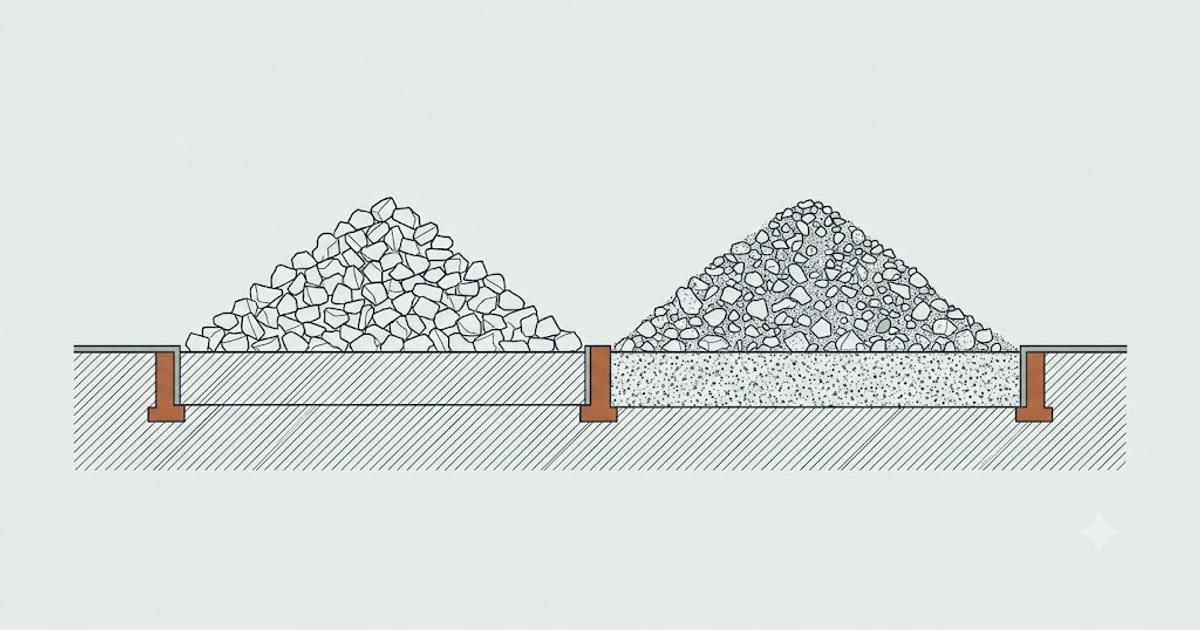
- #57 — ¾ inch, clean, no fines. Drains freely, does not compact. Drainage, French drains, under slabs.
- Crusher run (#21A, ¾ minus) — ¾ inch down to dust. Compacts hard. Base courses, driveways.
- #8 — ⅜ inch, clean. Paver bedding, in newer open-graded systems.
- Pea gravel — rounded, ⅜ inch. Decorative, drainage. Does not lock together and migrates underfoot.
- Rip rap — 4 inches and up. Erosion control, slopes.
The critical distinction is clean versus with fines. Clean stone drains and never compacts. Stone with fines compacts and does not drain. Using one where the other belongs is the single most common gravel error, and it produces either a soft base or a drain that silts up in a season.
Sub-base under concrete
Four inches of compacted #57 or crusher run under a slab is standard, and its purpose is not strength — it is uniformity. A slab bearing evenly on stone cracks less than a slab bearing on soil that is stiff in one place and soft in another.
Work out both together: the slab calculator for the concrete, this one for what goes under it.