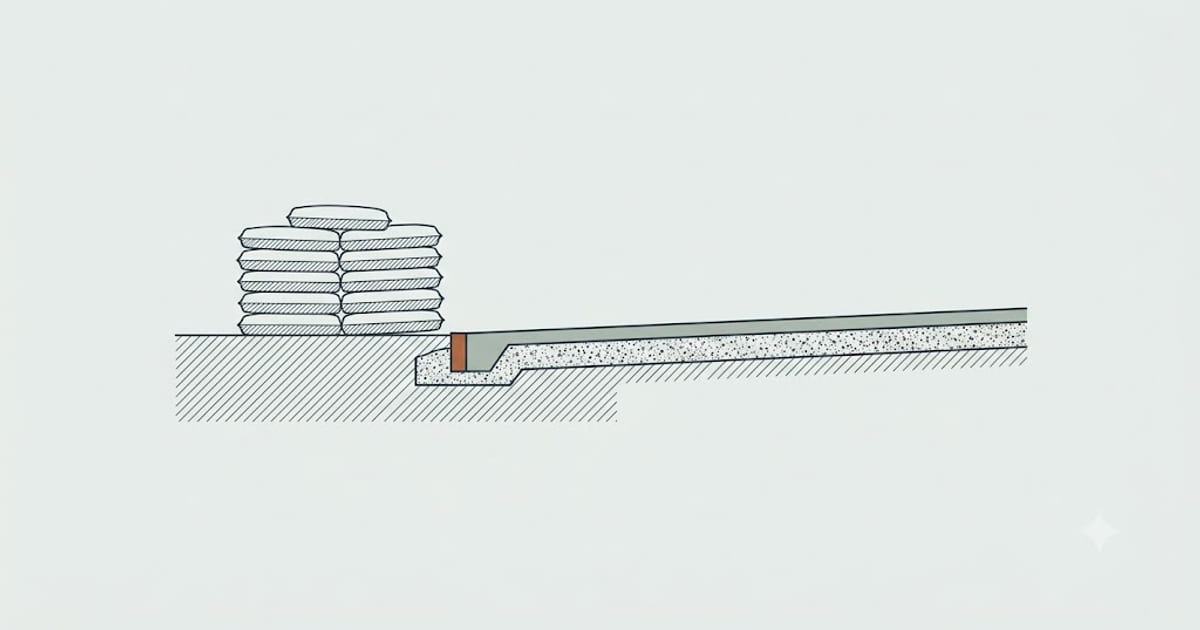
"About a bag per square foot" is a figure people repeat on job sites. It is roughly true for 80 lb bags at 5 inches, and wrong everywhere else — by a factor of nearly four across the range of common combinations.
The underlying arithmetic is one step, and once you have the table you never need the rule of thumb. For sizing the whole pour rather than a per-foot figure, see how much concrete you need for a slab.
The arithmetic
Each square foot of slab at thickness t inches contains t ÷ 12 cubic feet of concrete. Divide that by the bag's yield and you have bags per square foot.
| Thickness | ft³ per sq ft | 80 lb | 60 lb | 50 lb | 40 lb |
|---|---|---|---|---|---|
| 3″ | 0.250 | 0.42 | 0.56 | 0.67 | 0.83 |
| 4″ | 0.333 | 0.56 | 0.74 | 0.89 | 1.11 |
| 5″ | 0.417 | 0.69 | 0.93 | 1.11 | 1.39 |
| 6″ | 0.500 | 0.83 | 1.11 | 1.33 | 1.67 |
| 8″ | 0.667 | 1.11 | 1.48 | 1.78 | 2.22 |
Yields are for a standard general-purpose concrete mix: 0.60 ft³ for 80 lb, 0.45 for 60 lb, 0.375 for 50 lb, 0.30 for 40 lb. Quikrete publishes these on the product page and on the sack itself.
Multiply the figure by your slab area, and add ten to fifteen percent for the sub-base.
The number people actually want
For a 100 sq ft slab at 4 inches — the most common combination there is:
| Bag size | Bags needed | Total weight |
|---|---|---|
| 80 lb | 56 | 4,480 lb |
| 60 lb | 74 | 4,440 lb |
| 50 lb | 89 | 4,450 lb |
| 40 lb | 111 | 4,440 lb |
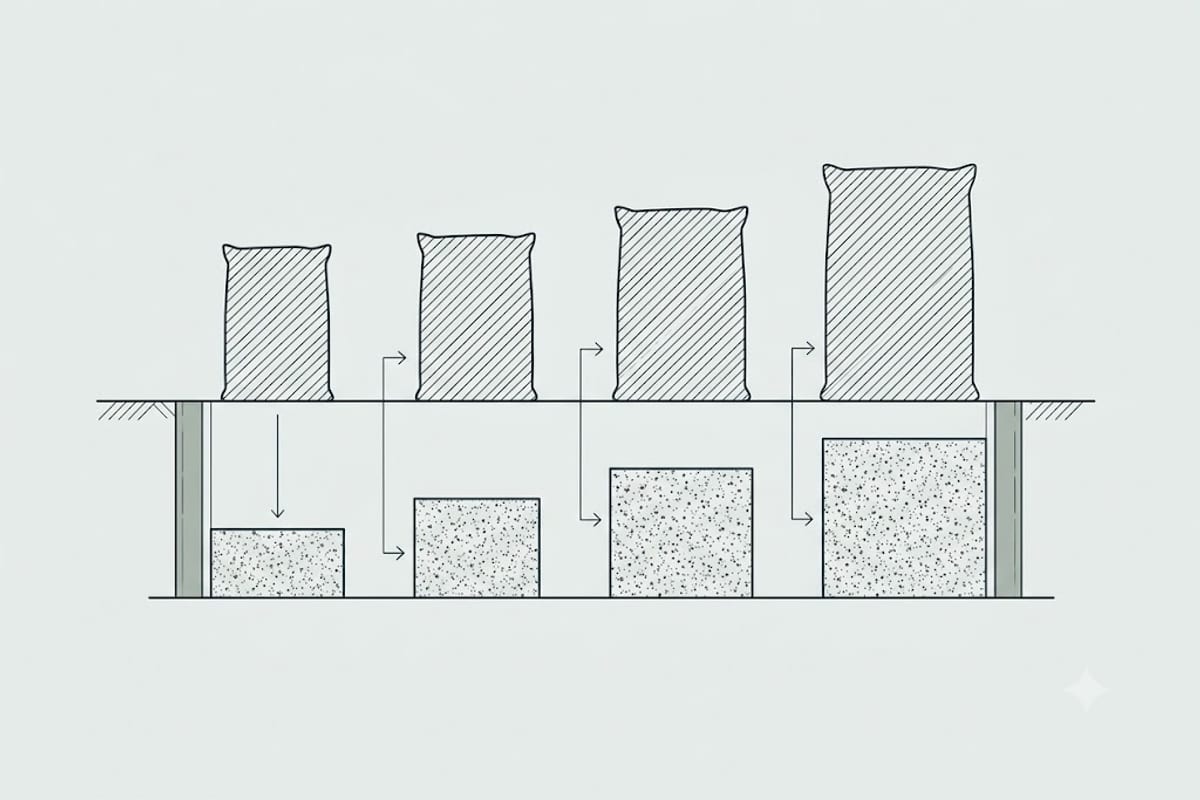
Look at the right-hand column. The total weight is the same whatever bag you choose, because you are buying the same volume of the same material. What changes is how many times you bend down.
That makes bag size a decision about handling, not about cost or quantity:
- 80 lb bags — fewest lifts, fewest bags to open, fewest trips. Also 80 lb per lift, which is a genuine consideration for one person working alone for four hours.
- 60 lb bags — the usual compromise, and the size most commonly stocked in quantity.
- 40 and 50 lb bags — noticeably more bags for the same pour, but manageable one-handed and easier if you are carrying them any distance or up steps.
There is often a small price advantage per unit volume in the larger bags. It is rarely large enough to matter next to the difference in how you feel at the end of the day.
Yield is per product, not per weight
This is where the table stops being universal. Two 80 lb bags from the same manufacturer can have different yields, because the aggregate blend differs:
- Standard concrete mix — the yields used above.
- Fast-setting mix — usually a similar yield but with a working time measured in minutes, which changes how many bags you can mix at once.
- High-strength mix — often a slightly different yield, and a different water requirement.
- Sand mix and mortar mix — not concrete, no coarse aggregate, entirely different yields, and not suitable for a structural slab.
Read the yield off the bag you are buying. It is printed there precisely because it varies.
Where the practical ceiling is
Bags stop making sense somewhere between one and two cubic yards, and the per-square-foot table shows why. At 4 inches:
- 100 sq ft = 56 bags of 80 lb. A long but ordinary afternoon for one person with a mixer.
- 200 sq ft = 111 bags. Two people, most of a day, and the first batch is curing while you mix the last.
- 400 sq ft = 222 bags. Nearly 18,000 lb of material to move by hand. Order the truck.
The hidden problem past a certain point is not effort, it is consistency. Every batch you hand-mix has a slightly different water content, and the batches mixed at hour five are wetter than the ones mixed at hour one, because tired people add water to make the mix easier to move. That variation becomes a slab with inconsistent strength and a surface that wears unevenly.
What this page does not cover
- Sub-base allowance — the table is geometric. Real slabs need ten to fifteen percent more; see the main slab page for why.
- Water quantity is on the bag and varies by product. Adding more than specified reduces strength significantly, and it is the easiest mistake to make.
- Mixing capacity — a typical portable mixer takes two or three 80 lb bags per batch. Divide your bag count by that to find how many batches you are committing to.
- Thickness is a structural decision and comes from your local code, not from this table.
Bags per square foot is one division. The useful part is knowing that the weight is the same either way.