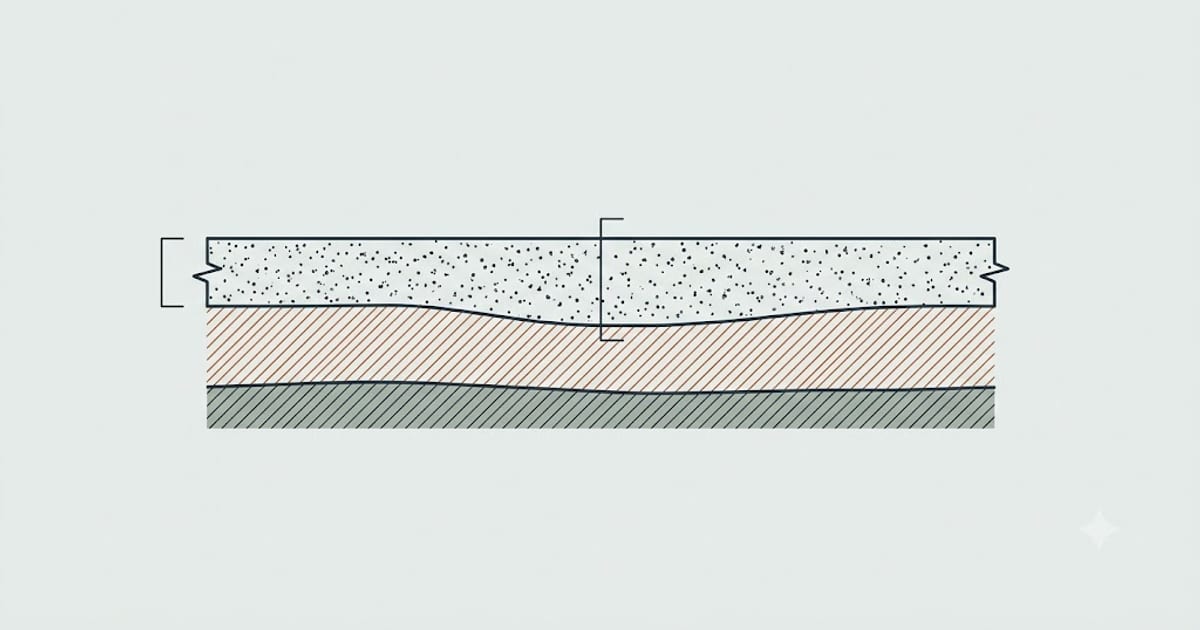
The volume arithmetic takes about ten seconds:
area in square feet × thickness in feet ÷ 27 = cubic yards
Almost nobody gets that wrong. People still run short, and the shortfall is usually somewhere between five and fifteen percent — which on a two-yard pour means a wheelbarrow you did not plan for, mixed in a panic while the first half is already going off.
The reason is not in the formula. It is in the ground underneath.
The geometric answer
Start here, because you need it before you can adjust it. This is the pure arithmetic, ignoring reality:
| Slab | Area | 4″ thick | 5″ thick | 6″ thick |
|---|---|---|---|---|
| 4 × 4 ft | 16 sq ft | 0.20 yd³ | 0.25 yd³ | 0.30 yd³ |
| 8 × 10 ft | 80 sq ft | 0.99 yd³ | 1.23 yd³ | 1.48 yd³ |
| 10 × 10 ft | 100 sq ft | 1.23 yd³ | 1.54 yd³ | 1.85 yd³ |
| 10 × 12 ft | 120 sq ft | 1.48 yd³ | 1.85 yd³ | 2.22 yd³ |
| 12 × 12 ft | 144 sq ft | 1.78 yd³ | 2.22 yd³ | 2.67 yd³ |
| 10 × 20 ft | 200 sq ft | 2.47 yd³ | 3.09 yd³ | 3.70 yd³ |
| 12 × 20 ft | 240 sq ft | 2.96 yd³ | 3.70 yd³ | 4.44 yd³ |
| 16 × 20 ft | 320 sq ft | 3.95 yd³ | 4.94 yd³ | 5.93 yd³ |
| 20 × 20 ft | 400 sq ft | 4.94 yd³ | 6.17 yd³ | 7.41 yd³ |
| 24 × 24 ft | 576 sq ft | 7.11 yd³ | 8.89 yd³ | 10.67 yd³ |
One cubic yard is 27 cubic feet. That single conversion is where the yard figure comes from, and it is worth memorising because every other number on this page hangs off it.
Bags, and what one actually holds
If you are mixing from bags rather than ordering a truck, the number you need is the yield — how much finished concrete one bag makes. It is printed on the bag and it is not proportional to the weight in the way people assume, because different products have different densities.
For Quikrete Concrete Mix, the standard general-purpose product:
| Bag | Yield | Bags per cubic yard |
|---|---|---|
| 80 lb | 0.60 ft³ | 45 |
| 60 lb | 0.45 ft³ | 60 |
| 50 lb | 0.375 ft³ | 72 |
| 40 lb | 0.30 ft³ | 90 |
Two things in that table matter more than the headline numbers.
Yield is per product, not per weight. An 80 lb bag of Quikrete Concrete Mix yields 0.60 ft³. An 80 lb bag of a fast-setting or high-strength product from the same manufacturer does not necessarily yield the same, because the aggregate blend differs. Check the bag you are actually buying rather than reusing a number you remember.
Forty-five bags is one cubic yard. Hold onto that. It is the number that tells you when bagging stops making sense, and we come back to it below.
Put the two tables together and a 10 × 10 ft patio at 4 inches — the single most searched slab size — needs 1.23 cubic yards, or 56 bags of 80 lb mix. That is roughly a full pallet, about 4,500 lb of material, and somewhere between four and six hours of mixing for one person.
Now the part the calculators leave out
Every number above assumes your sub-base is perfectly flat. It is not. It has never been flat on any site anywhere, and the direction of the error is always the same: the middle sits lower than the edges, because that is where you walked while you were compacting it.
The slab surface is screeded flat. The ground is not. So the concrete fills the difference, and your slab is thicker than nominal everywhere the ground dips.
Here is what that costs you:
| Nominal thickness | Real average after dishing | Extra concrete |
|---|---|---|
| 4″ | 4¼″ | +6.2 % |
| 4″ | 4½″ | +12.5 % |
| 4″ | 5″ | +25.0 % |
| 5″ | 5½″ | +10.0 % |
| 6″ | 6½″ | +8.3 % |
A half inch of dish on a four inch slab costs you an eighth of the total pour. On that 10 × 10 patio, 12.5 % is seven extra bags. Seven bags is exactly the kind of shortfall that has you in the truck to the yard with concrete already curing in the barrow.
Notice that the penalty shrinks as the slab gets thicker — a half inch of dish is 12.5 % of a 4″ slab but only 8.3 % of a 6″ one. Thin slabs are the ones that punish sloppy sub-base preparation, which is the opposite of most people's intuition.
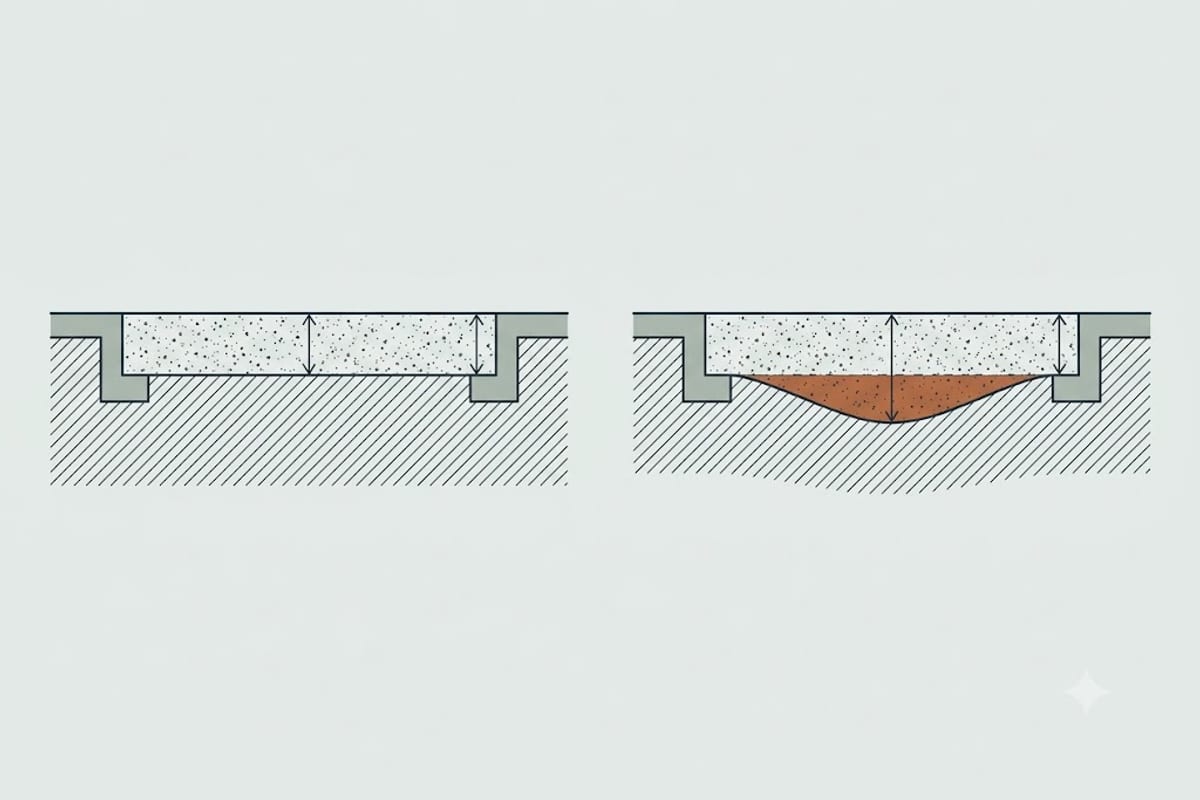
The practical rule: order 10 % over the geometric figure for a well-prepared sub-base you compacted properly and checked with a straightedge. Order 15 % over if you did not check, or if the fill is anything other than clean compacted gravel. Nobody has ever regretted half a barrow of leftover concrete; everybody remembers running out.
How thick, and who decides
Thickness is not a preference. It follows from what will sit on the slab:
- 4 inches — foot traffic only. Patios, walkways, shed floors, air-conditioner pads.
- 5 to 6 inches — passenger vehicles. Driveways, garage floors, parking pads.
- 6 inches and up, with engineered reinforcement — anything carrying loaded trucks, heavy equipment, or a structure.
Those bands are the common residential practice reflected in ACI guidance for residential concrete, and your local building department may be stricter. Two points worth being blunt about:
This page is about quantity, not structure. Thickness, reinforcement, control joint spacing and sub-base bearing capacity are structural decisions. If the slab supports anything more than furniture and feet, the specification comes from your local code and, above a certain point, from an engineer — not from a table on the internet, this one included.
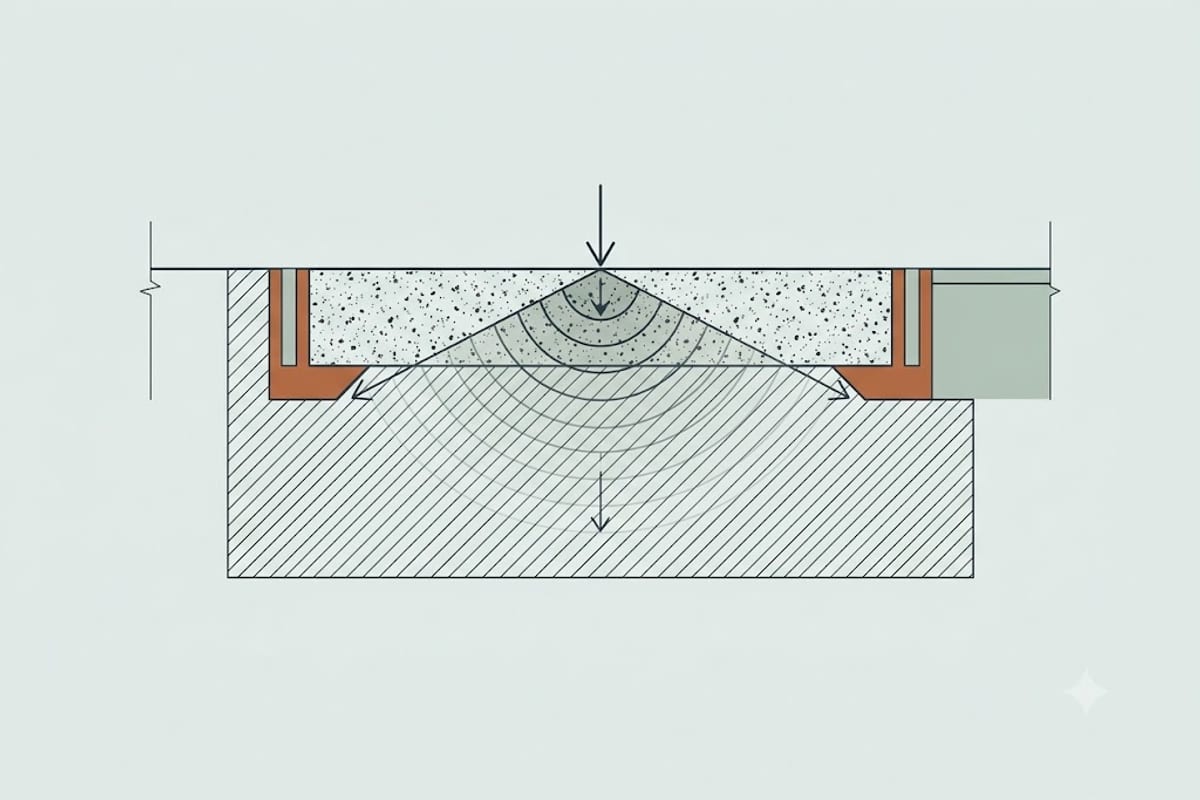
Thickness beats reinforcement for load spreading. Mesh and rebar control crack width after cracking starts; they do not meaningfully stop the slab flexing. If you are choosing between adding reinforcement and adding an inch, the inch does more.
When to stop bagging and call the truck
Forty-five bags per cubic yard is the number that answers this.
Below about 1 cubic yard, bags win on every count: no minimum charge, no short-load fee, no schedule, no wasted material, and you can pour in stages.
Between 1 and 2 cubic yards, it depends on how many hands you have. Two yards is 90 bags of 80 lb mix. That is 7,200 lb of material to move, open and mix, and it does not go well alone in warm weather because the first batch is setting while you are mixing the twelfth.
Above 2 cubic yards, ready-mix wins almost always, even paying a short-load fee. The material arrives mixed to a consistent water-cement ratio, which matters: hand-mixed batches vary, and the batches you mix at hour five have more water in them than the ones you mixed at hour one, because by then you are tired and wet concrete is easier to move. That variation shows up later as a slab with inconsistent strength and surface hardness.
Worked example, end to end
A 12 × 20 ft driveway extension at 5 inches, on gravel fill you compacted with a plate but did not straightedge:
- Geometric volume: 240 sq ft × (5 ÷ 12) ft ÷ 27 = 3.70 yd³
- Sub-base allowance: unchecked fill, so add 15 % → 3.70 × 1.15 = 4.26 yd³
- Bags or truck: well over 2 yd³, so ready-mix. Order 4.5 yd³ — round up to the half yard, because plants batch in half-yard increments and being 0.24 yd³ short is a disaster while being 0.24 yd³ over is a wheelbarrow of fill for a low spot in the garden.
If you insisted on bagging it: 4.26 yd³ × 45 = 192 bags of 80 lb. Roughly 15,400 lb of material. Do not.
What this page does not tell you
- Nothing here is a structural specification. Volume is arithmetic; load capacity is engineering.
- Yields are for one manufacturer's general-purpose mix. Fast-setting, crack-resistant and high-strength products differ. Read the bag.
- Odd shapes need breaking up. Split an L-shape into rectangles, calculate each, add them. For circles use π × radius² for the area and carry on as normal.
- Slope changes everything. A slab poured to a drainage fall is a wedge, not a prism. Average the two thicknesses — measure at the thick end and the thin end, take the mean, and use that.
The number you want is not hard to calculate. It is just bigger than the geometry says, and the gap lives underground where nobody looks until the truck is leaving.
Read next
- Converting a Slab to Cubic Yards, and Why Plants Only Sell in Halves — Cubic yards is the unit the truck arrives in, and it is the only unit the plant will talk to you about.
- Concrete for a 10 × 10 Patio: Every Number, Start to Finish — The most searched slab size there is.
- Bags of Concrete per Square Foot, by Thickness and Bag Size — One bag per square foot is a number people repeat.
- Driveway Slab Thickness: What the Extra Inch Buys You — Four inches is a patio.