Every ready-mix plant in the country sells concrete by the cubic yard, and most of them batch in half-yard increments. So whatever units you measured your slab in, the conversation ends in yards — and the number you say out loud is not the number your calculator produced.
The full method for sizing a pour, including the sub-base allowance that catches most people, is in how much concrete you need for a slab. This page is about the conversion itself.
One number to remember
27. A cubic yard is three feet by three feet by three feet, which is 27 cubic feet. Every other conversion on this page follows from it.
cubic yards = length (ft) × width (ft) × thickness (ft) ÷ 27
The trap is thickness, because nobody measures a slab in feet. Convert inches to feet by dividing by twelve, and do it before anything else:
| Thickness | In feet |
|---|---|
| 3″ | 0.250 |
| 4″ | 0.333 |
| 5″ | 0.417 |
| 6″ | 0.500 |
| 8″ | 0.667 |
A 4-inch slab is one third of a foot. Working that out first, rather than mid-formula, prevents the single most common arithmetic error in the whole exercise: multiplying by 4 instead of by 0.333, which produces an answer twelve times too large and is usually caught, and multiplying by 0.4 instead of 0.333, which produces an answer twenty percent too large and usually is not.
Worked, in order
A 12 × 16 ft slab at 5 inches:
- Thickness to feet: 5 ÷ 12 = 0.417 ft
- Volume in cubic feet: 12 × 16 × 0.417 = 80.0 ft³
- To cubic yards: 80.0 ÷ 27 = 2.96 yd³
That is the geometric answer. It is not the order.
Why the order is bigger
Two adjustments stand between the calculation and the phone call.
The sub-base. Your ground is not flat, and the concrete fills whatever dip is there. Ten percent over is the minimum sensible allowance on well-prepared fill; fifteen percent if you did not check it with a straightedge. On the example above, 2.96 × 1.10 = 3.26 yd³.
The half-yard step. Plants batch in halves. You cannot order 3.26 yards; you order 3.5. That rounding is not waste, it is insurance — and the alternative, being a quarter yard short with the truck pulling away, is a genuinely bad afternoon.
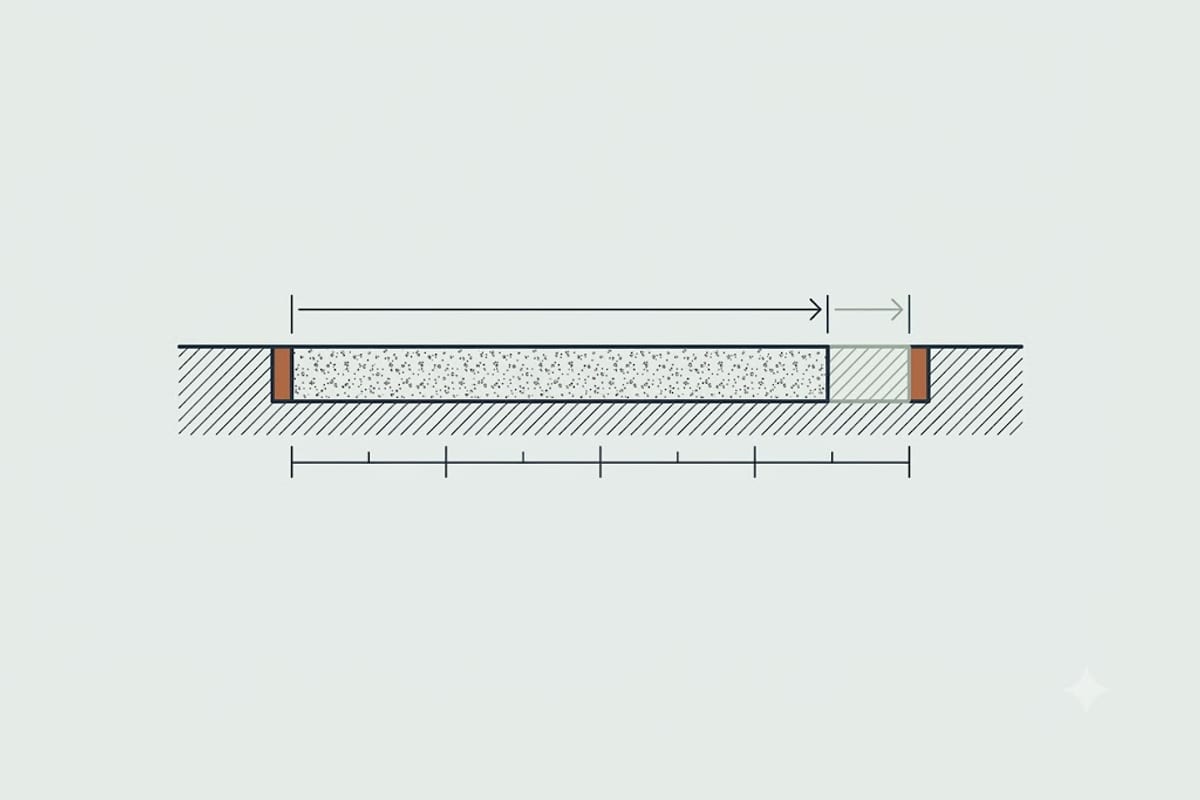
So the sequence is always: calculate, add the sub-base allowance, round up to the next half yard. Three steps, in that order, every time.
Short load fees
Below a certain volume — commonly around 4 to 5 cubic yards, though it varies by plant and region — you pay a short load fee on top of the material. The truck holds around 9 to 10 yards and costs the same to send out whether it is full or carrying two.
This changes the economics of rounding in a way worth knowing: if you are already paying a short load fee, the marginal cost of an extra half yard is only the material. When you are close to a boundary, taking the larger figure costs very little and removes the entire class of problem where you run out.
It also means combining pours is worth thinking about. Two separate 2-yard pours on different weekends pay two short load fees. One 4-yard pour pays one.
Odd shapes
The formula assumes a rectangle. For anything else, break it up:
- L-shapes and T-shapes — split into rectangles along a line, calculate each, add. Take care not to double-count the overlap square.
- Circles — area is π × radius², then multiply by thickness in feet and divide by 27. For a 10 ft diameter circular pad at 4″: 3.1416 × 5² = 78.5 ft², × 0.333 = 26.2 ft³, ÷ 27 = 0.97 yd³.
- Slopes — a slab poured to a fall is a wedge. Measure the thickness at both ends, take the average, and use that as a uniform thickness. The error from averaging is negligible on a normal drainage fall.
- Thickened edges — many slabs are deeper at the perimeter. Calculate the flat slab, then add the extra as a separate long thin box: perimeter length × extra depth × edge width.
Metric, if your plans are in metres
The equivalent is simpler, because cubic metres need no conversion factor:
cubic metres = length (m) × width (m) × thickness (m)
One cubic metre is 1.308 cubic yards; one cubic yard is 0.765 cubic metres. If you are converting a supplier's yard figure to metres or back, those are the two numbers.
What this page does not cover
- The sub-base allowance is explained properly in the main slab page, including how much a given amount of dishing actually costs you.
- Bag counts are a different conversion, driven by the yield of the specific product rather than by volume alone.
- Thickness is a structural decision. Nothing here tells you how thick your slab should be, only how to convert whatever thickness you have decided on.
- Plants differ. Minimum orders, increments and short load thresholds are local. Ask before you calculate to the nearest hundredth.
One division by 27, one allowance for the ground, one round up to the half. That is the whole conversion.