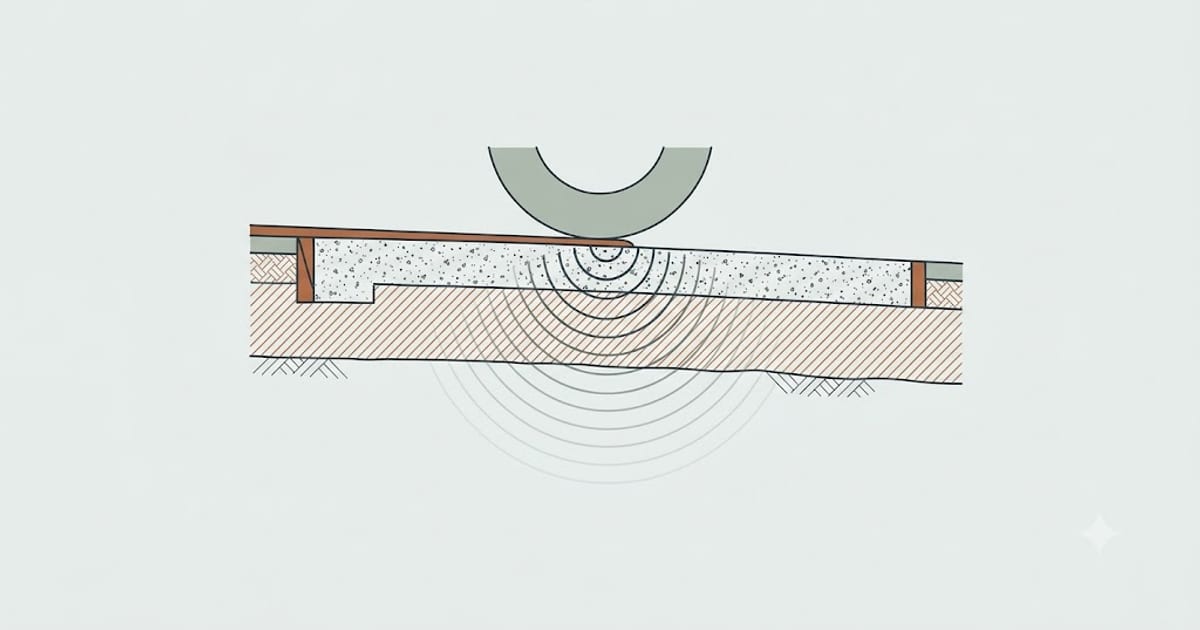
A patio and a driveway are the same material laid the same way, and they are not the same slab. The difference is that a driveway carries a vehicle, and a vehicle puts its entire weight through four contact patches roughly the size of a sheet of paper each.
Once you have decided on a thickness, the volume calculation is straightforward. Deciding is the part worth thinking about.
The common bands
| Use | Typical thickness |
|---|---|
| Patios, walkways, shed floors | 4″ |
| Passenger cars, standard driveways | 5″ |
| Light trucks, regular heavier vehicles | 6″ |
| Loaded trucks, RVs, equipment | 6″+ with engineered reinforcement |
These reflect common residential practice, which is documented in ACI guidance for residential concrete. Your local building department may require more, and where it does, that requirement wins. A driveway apron meeting a public road is frequently governed separately by the municipality, sometimes with a different thickness and a different mix specification from the rest of the drive.
Why an inch matters more than it sounds
A slab works by spreading a concentrated load out over a wide enough area of base that the base can carry it. The wheel presses down on a small patch; the slab distributes that pressure sideways as it travels down through the concrete; the base receives it across a much larger area at a much lower pressure.
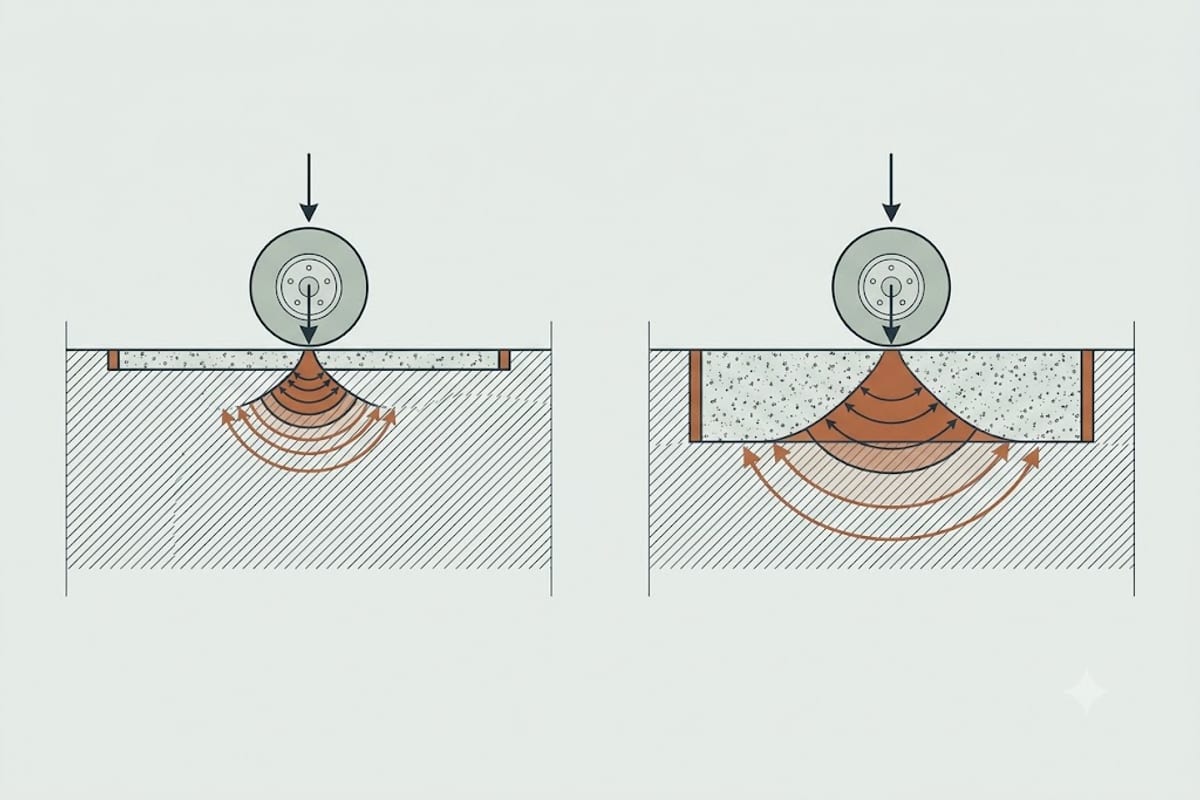
The thicker the slab, the further the load can spread before it arrives at the base. Going from 4 to 5 inches is a 25 % increase in thickness, and it buys considerably more than a 25 % improvement in how well the slab resists bending — because a slab's stiffness in bending rises much faster than its thickness does.
That is the practical answer to "is the extra inch worth it": on a driveway, yes, and it is the cheapest structural improvement available. An inch across a 20 × 20 ft drive is about 1.2 cubic yards of extra concrete. Compare that with the cost of breaking out and replacing a cracked drive.
Reinforcement does a different job
The most persistent misconception in residential concrete is that mesh or rebar lets you use a thinner slab. It does not.
Reinforcement controls crack width after cracking has started. It holds the two sides of a crack together so the slab keeps acting as one piece and the crack stays tight rather than opening and stepping. It does very little to stop the slab flexing in the first place, because at the point of first cracking the steel has barely begun to take load.
So the two are not alternatives:
- Thickness decides whether the slab flexes enough to crack.
- Reinforcement decides what happens after it does.
If you are choosing between adding an inch of concrete and adding mesh to a thin slab, the inch does more. If you can do both, do both — a 5-inch drive with mesh at mid-depth is a considerably better slab than either alone.
Mesh in the bottom of the pour does nothing. It has to sit in the upper middle of the slab to be useful, which means chairs or hooks, not laying it on the base and hoping it gets pulled up during the pour. That trick does not work, and it is where a large fraction of reinforced residential slabs quietly fail to be reinforced.
The base is half the slab
A thick slab on a poor base performs worse than a thinner slab on a good one. The base has three jobs: carry the spread load without settling, drain water away from underneath, and provide a uniform surface so the slab is not left spanning a soft spot.
Three things that matter more than most people expect:
- Compaction in layers. Fill dumped and levelled is not compacted fill. It goes in in lifts of a few inches, each one compacted, or it settles later and takes the slab with it.
- Uniformity beats depth. A base that is 4 inches everywhere is better than one that is 8 inches in places and 2 in others. Differential settlement cracks slabs; uniform settlement mostly does not.
- Drainage. Water under a slab is a problem in any climate and a serious one where the ground freezes.
Control joints are not optional
Concrete shrinks as it cures, and shrinkage cracks are certain. Control joints decide where they go by giving the slab a deliberate weak line to crack along, below the surface where it does not show.
They need to be cut deep enough to work — roughly a quarter of the slab depth — and spaced so no panel is much longer than it is wide. A long thin panel cracks across the middle regardless of what you do. Joints cut too shallow are decoration, and the slab cracks somewhere else.
What this page does not cover
- This is not a structural specification. Anything beyond ordinary passenger vehicles, and anything supporting a structure, needs local code and often an engineer.
- Frost depth and soil type change the base requirement substantially, and both are local.
- Mix strength is a separate specification from thickness. A thicker slab in a weak mix is not a straightforward trade.
- The apron where your drive meets the public road is usually the municipality's specification, not yours.
Decide the thickness first, from the vehicle and the code. Everything else, including the volume, follows from it.