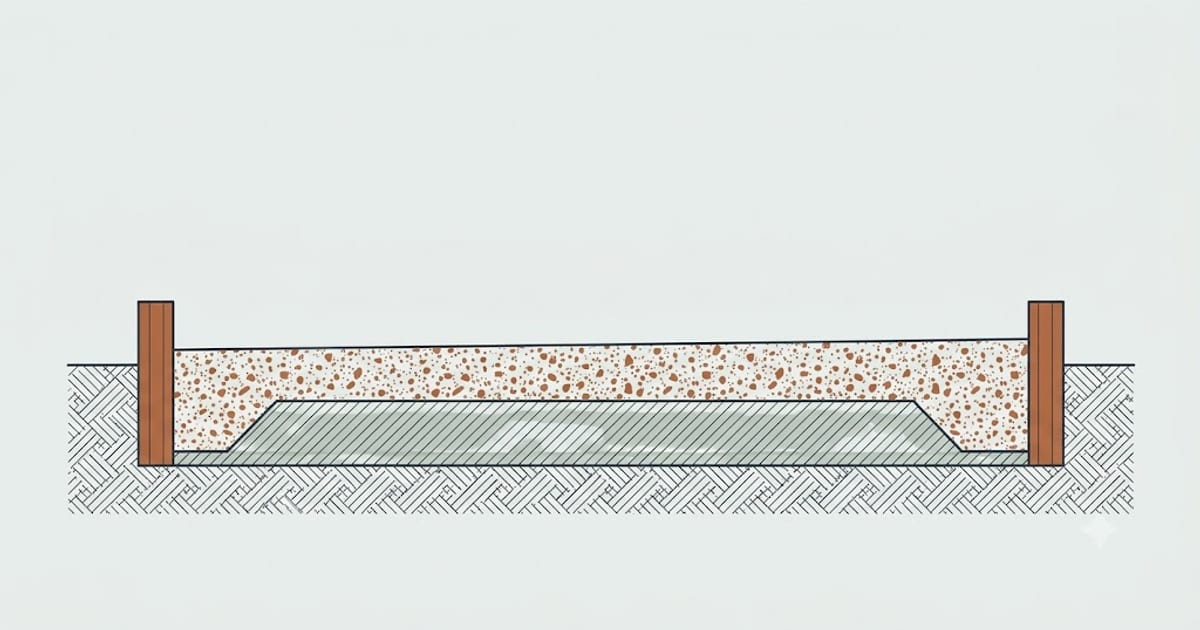
Ten by ten at four inches is the most searched slab size there is, and it sits almost exactly on the line where bags stop being obviously right. Here is every number for it.
The general method, including why the geometric figure is never the order, is in how much concrete you need for a slab.
The figures
| Value | |
|---|---|
| Area | 100 sq ft |
| Thickness | 4″ = 0.333 ft |
| Volume | 33.3 ft³ |
| Cubic yards | 1.23 yd³ |
| With 10 % sub-base allowance | 1.36 yd³ |
| With 15 % sub-base allowance | 1.42 yd³ |
And in bags, at the geometric volume:
| Bag size | Bags | Total weight |
|---|---|---|
| 80 lb | 56 | 4,480 lb |
| 60 lb | 74 | 4,440 lb |
| 50 lb | 89 | 4,450 lb |
Add ten percent to those bag counts for the sub-base and you are at 62 bags of 80 lb, or about a pallet and a quarter. A standard pallet is commonly 42 bags of 80 lb, so this is two pallets with change, or one pallet plus loose bags.
Bags or truck
At 1.23 cubic yards this sits right on the boundary, and the honest answer depends on how many people are working.
Bags make sense if: you have a mixer, you have most of a day, and ideally a second person. Sixty-two bags is roughly 20 to 25 mixer batches. It is a long afternoon but an entirely normal DIY job, and you can stop and start.
Ready-mix makes sense if: you are working alone, the weather is warm, or access is easy for a truck. You will pay a short load fee at this volume — the truck holds seven times what you need — but you get a consistent mix delivered in ten minutes rather than five hours of increasingly tired batches.
The consistency argument is the real one. Every hand-mixed batch has slightly different water content, and the batches you mix at hour four have more water than the ones at hour one, because wetter concrete is easier to move when you are tired. More water means less strength. A truck gives you one mix for the whole slab.
Pouring it in sequence
If you are bagging it, you are not pouring a 10 × 10 slab. You are pouring a series of strips that have to knit together before the previous one sets.
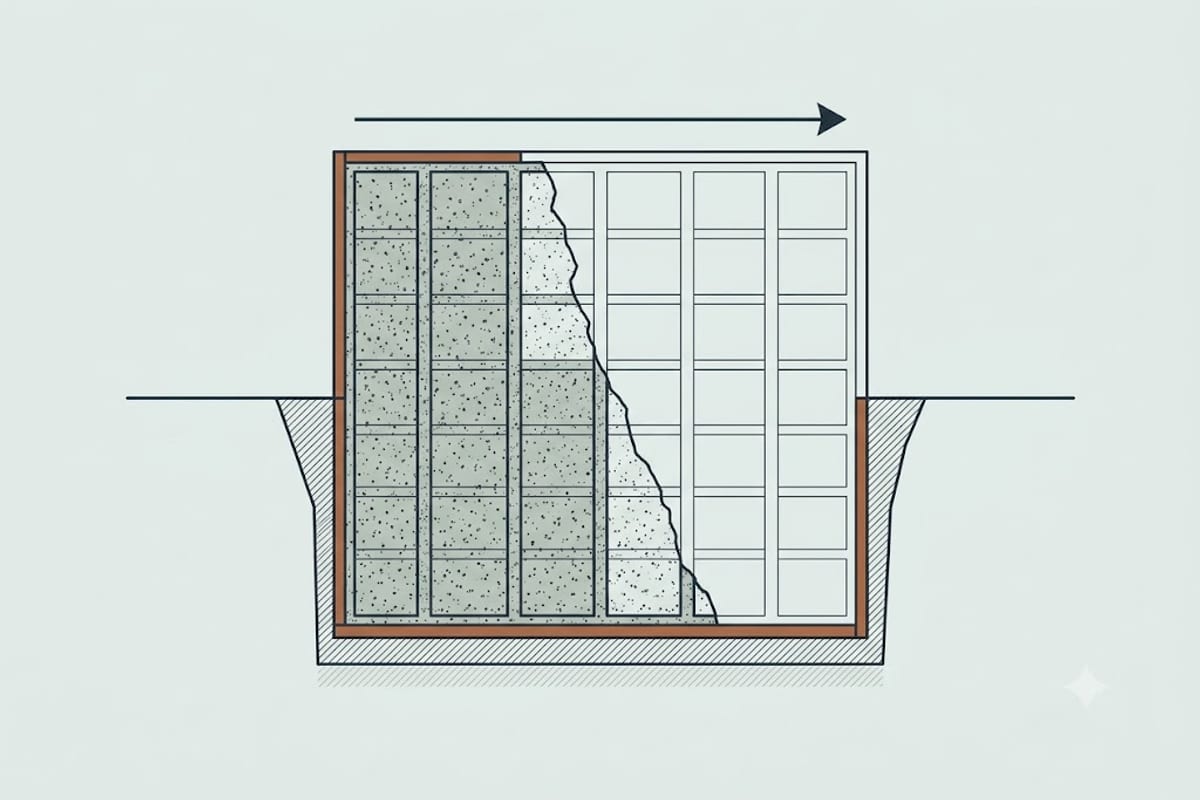
Work in strips across the short dimension, keep a wet edge, and screed each strip against the one before it while that edge is still workable. The moment a previous strip has stiffened past the point where new concrete will blend into it, you have a cold joint — a permanent plane of weakness through the slab that will eventually show as a crack.
In warm weather that window is short. Practical consequences:
- Mix continuously. The moment you stop to rest is the moment the edge goes off.
- Start early on a hot day, or wait for an overcast one.
- Have everything ready first. Formwork, screed board, float, edger, and the whole quantity of bags open and to hand. Nobody should be driving to the store mid-pour.
What else the day needs
Concrete is the item people plan for. These are the ones that get forgotten:
- Formwork — 40 linear feet of board for the perimeter, plus stakes every 2 to 3 feet. Set to the finished height, checked level, with any drainage fall built in.
- Base material — 4 inches of compacted gravel under a 100 sq ft slab is about 1.2 cubic yards of gravel, which is a delivery of its own.
- A fall for water. A patio should shed water away from the house at roughly a quarter inch per foot. Over 10 feet that is 2.5 inches of drop across the slab, and it must be built into the formwork before anything is poured.
- Expansion joint where the slab meets the house, so the two can move independently.
- Control joints cut into the finished slab. A 10 × 10 panel usually wants one cut down the middle, giving two 5 × 10 panels, or a cross giving four 5 × 5.
Other thicknesses and sizes
If the patio will take anything heavier than furniture:
| Size | 4″ | 5″ | 6″ |
|---|---|---|---|
| 10 × 10 | 1.23 yd³ | 1.54 yd³ | 1.85 yd³ |
| 10 × 12 | 1.48 yd³ | 1.85 yd³ | 2.22 yd³ |
| 12 × 12 | 1.78 yd³ | 2.22 yd³ | 2.67 yd³ |
Note that a 12 × 12 at 4 inches needs 45 % more concrete than a 10 × 10 — area scales with both dimensions, so a two-foot increase on each side is a much bigger jump than it feels like when you are pacing it out in the garden.
What this page does not cover
- Sub-base allowance is explained in the main slab page; the figures above show it but not the reasoning.
- Finishing — floating, edging, brooming and curing all happen after the numbers on this page stop mattering, and they decide how the slab looks for the next twenty years.
- Curing matters more than most people expect. Concrete gains strength through hydration, not drying, and keeping it damp for the first several days makes a measurable difference.
- Permits. Many jurisdictions require one for a slab of this size, particularly near a property line.
One hundred square feet, 1.23 cubic yards, 62 bags with the allowance. The rest of the day is everything that is not concrete.